Multitasking Damage to Your Brain: 7 Shocking Facts Research Reveals
In this article, we walk through what psychologists, neuroscientists, and workplace researchers have actually found about multitasking damage to your brain.
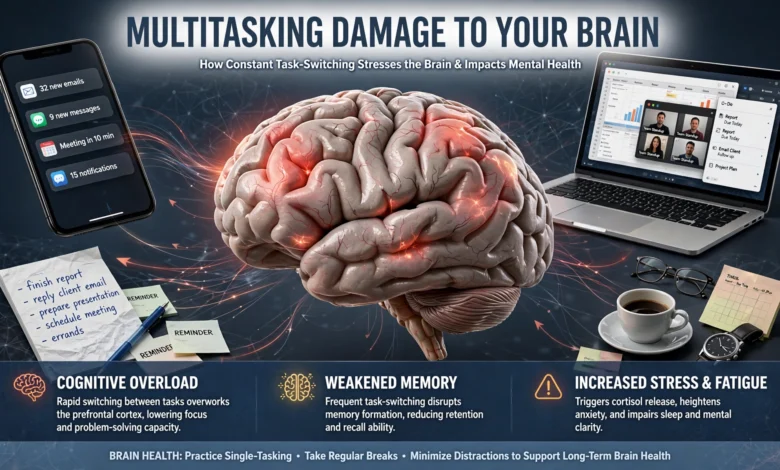
Multitasking feels like a superpower. You answer a message during a video call, skim a report while eating lunch, and keep three browser tabs open “just in case.” At the end of the day, you feel busy, so you assume you got a lot done. The research on multitasking tells a different story. Decades of studies suggest that multitasking is not really doing two things at once. It is switching between them very fast, and every switch has a price.
The price of multitasking shows up as lost time, more mistakes, weaker memory, and a mind that finds it harder to settle on one thing. Some people go further and claim that multitasking damages your brain for good. That is a bigger claim about multitasking, and the honest answer is more careful than most headlines admit.
You will see where the evidence on multitasking is strong, where it is only a correlation, and where scientists still disagree. We cover task switching, the switch cost, attention residue, memory, stress, and brain structure, then finish with practical steps to protect your focus without turning into a robot.
If you have ever ended a workday wondering why you feel drained but did not finish anything important, multitasking may be part of the reason. Let’s start with the short answer.
Does Multitasking Damage Your Brain? The Short Answer
The short answer is this: multitasking clearly hurts performance, and multitasking may be linked to changes in how your brain handles attention, but there is no solid proof yet that it causes permanent brain damage.
Here is how the evidence on multitasking breaks down:
- Strong evidence: Multitasking, in the form of switching between tasks, slows you down and raises your error rate. Lab experiments have shown this for more than twenty years.
- Strong evidence: Interruptions, a forced form of multitasking, make it hard to return to deep work, and the recovery time is measured in minutes, not seconds.
- Moderate evidence: People who multitask heavily with media tend to score worse on attention and memory tests.
- Weak or unclear evidence: Some brain imaging work links heavy media multitasking to lower volume in a region called the cingulate cortex, but nobody knows whether multitasking shrinks that region or whether people with a smaller region are simply more drawn to multitasking.
The Brown University Health team puts it plainly: the effects of multitasking are likely short term, but there are no definitive studies to answer that question fully. So “damage” is probably the wrong word for what we can prove about multitasking today. “Cost” is the right one. The seven facts below show how big the cost of multitasking can get.


Fact 1: Multitasking Is Really Rapid Task Switching
Most of us use the word multitasking for anything that involves more than one activity at a time. Scientists are stricter. They separate two situations. In the first, you do two tasks that barely need thinking, like walking and listening to music. In the second, you try to handle two tasks that both need attention, like writing an email while following a meeting. Multitasking of the second kind is where the trouble starts.
Brown University Health notes that our brains are built more like “monotaskers,” meant to focus on and finish one task at a time. When you multitask, your brain does not split itself in half. Instead, multitasking makes it jump back and forth between tasks, and that constant jumping tires it out and makes it less efficient.
The Two Steps Behind Every Multitasking Switch
Psychologists Joshua Rubinstein, David Meyer, and Jeffrey Evans studied multitasking in a well-known set of experiments published in 2001. According to the American Psychological Association, they found that executive control, the system that manages your goals, works in two stages:
- Goal shifting: You decide, “I want to do this now instead of that.”
- Rule activation: Your brain turns off the rules for the old task and turns on the rules for the new one.
You do both steps without noticing. Each one takes a small amount of time and uses mental energy. When multitasking pushes you to switch a dozen times in an hour, you run that two-step process a dozen times.
Why Switching During Multitasking Is Never Free
A review in the National Institutes of Health’s PubMed Central library, Multicosts of Multitasking, explains that a switch cost is a drop in speed or accuracy that comes from moving between tasks. The authors note that these costs are almost always present: people usually take longer and make more errors when they switch than when they stay with one task. In other words, the slowdown is not a sign that you are bad at multitasking. It is how human attention works.
Fact 2: Multitasking Can Eat Up to 40% of Your Productive Time
The single most quoted number about multitasking comes from that same research. The APA reports that even brief mental blocks caused by shifting between tasks can cost as much as 40 percent of someone’s productive time.
That multitasking figure needs context. Each individual switch may cost only a few tenths of a second. The damage from multitasking comes from repetition. If you flip between an inbox, a chat window, and a spreadsheet dozens of times an hour, multitasking adds up those tiny losses into a big one.
Complexity and Familiarity Change the Cost of Multitasking
The original experiments showed that multitasking costs are not equal across all tasks:
- Harder tasks cost more. As the rules of a task got more complex, people lost more time switching to it.
- Unfamiliar tasks cost more. Participants recovered faster when they switched to something they already knew well.
- Clear cues help. When people got a hint about which task to do next, the cost dropped.
This explains why answering a quick text while cooking pasta feels fine, but switching from a financial model to a chat thread and back leaves you scrambled. The more demanding your work, the more expensive multitasking gets.
How Multitasking Mistakes Spill Over
There is another hidden cost. Research summarized by ScienceInsights describes a study where participants who made an error on one task showed error rates on the next task that nearly doubled at short intervals and more than tripled at slightly longer ones. Fixing a mistake uses the same mental resources you need for the next task, so multitasking can turn one small slip into several.
Fact 3: Multitasking Turns One Interruption Into a 23-Minute Detour
So far we have talked about multitasking that you choose. Interruptions are the version that gets forced on you, and they may be even more expensive. Multitasking at work often starts with an interruption rather than a decision.
Gloria Mark, an information scientist at the University of California, Irvine, spent years watching how knowledge workers spend their days. In a Gallup interview, she explained that most interrupted work was resumed on the same day, and that it took an average of 23 minutes and 15 seconds to get back to it. She also pointed out that people rarely return to the original task straight away. They usually pass through about two other tasks first, which makes the return trip longer.
That number is often quoted as if every interruption wastes exactly 23 minutes. It is an average across real workdays, so treat it as a sign of scale rather than a stopwatch. Still, it explains something most of us feel: a “quick question” can wreck the next half hour, and constant multitasking makes that wreckage a daily habit.
Attention Residue: Why Multitasking Leaves Your Mind Behind
Sophie Leroy, a researcher at the University of Washington, gave this effect a name in 2009: attention residue. Part of your mind stays stuck on the task you just left, especially if it was unfinished. That leftover thinking competes with the new task for space in your working memory, so multitasking leaves you performing worse on both.
Cal Newport, a computer science professor at Georgetown University, argues that even a glance can trigger it. As quoted by The MIT Press Reader, he says that looking at an email inbox for 15 seconds starts a cascade of cognitive changes. You may have closed the tab, but your brain has not closed the loop.
Fact 4: Heavy Multitasking Is Linked to Weaker Attention
Here is a twist that surprises many people. If multitasking were a skill, people who do it often should get better at it. The evidence suggests the opposite.
Brown University Health describes studies of people who rate as high media multitaskers, meaning they regularly use several devices at once, such as watching TV while scrolling a phone. These multitaskers showed poorer attention on cognitive tasks. They also had to use more of their brain to complete the same task compared to low multitaskers, which is a sign of lower efficiency.
Stanford University researchers reported a related pattern. Heavy media multitaskers were worse at filtering out irrelevant information, even when they were not multitasking, and they were slower at switching between tasks than people who focused on one thing at a time. The habit of multitasking, meant to sharpen their skill, seemed to dull it.
A Note of Caution on Multitasking, Cause and Effect
Be careful with this one. Most of these studies are correlational. They show that heavy multitasking and weaker attention go together. They do not prove that multitasking causes the weaker attention. It is just as possible that people who already struggle to filter distractions are more drawn to multitasking. The truth may be a bit of both.
Fact 5: Multitasking Weakens Memory and Learning
Memory is where the cost of multitasking is easiest to see in everyday life. Think about the last time you tried to read something while half-listening to a conversation. You probably reached the end of the page and realized nothing had stuck. That is multitasking at work.
To build a lasting memory, your brain needs focused attention at the moment you take in new information. Scientists call this the encoding stage. ScienceInsights summarizes decades of studies showing large drops in both recall and recognition when people try to learn something while doing a second task. Multitasking during encoding is where the most damage happens.
Stanford Neuroscience reports that multitasking can interfere with working memory, cause students to do worse in school, and could possibly even create potentially long-term memory problems. Note the careful wording: “could possibly.” The short-term effect of multitasking on learning is well supported. The long-term effect is still an open question.
Fact 6: Multitasking Raises Stress and Is Linked to Mood Problems
Multitasking does not only affect thinking. It also affects how you feel.
Brown University Health notes that multitasking temporarily increases stress levels, which raises blood pressure. Gloria Mark’s work on interrupted work points in the same direction: interruptions are associated with higher levels of stress, frustration, mental effort, and time pressure.
There is also research on mood. An editorial in PubMed Central on digital multitasking and brain health reports that people who often multitask are more likely to experience symptoms of depression and anxiety. The same caution applies here. This is an association, not proof of cause. Anxious people may reach for their devices more often, and a constant stream of pings may also make anxiety worse. Both can be true at once.
The practical point is simple. Even if multitasking never changed your brain’s structure, a day of constant switching leaves you more tense and more tired, and that alone is a good reason to cut back on multitasking.
Fact 7: Multitasking and Brain Structure, Damage Is Not Proven Yet
Now we reach the question in the title. Does multitasking physically change your brain?
One correlational study, described by Brown University Health, found that heavy media multitaskers had smaller brain volumes in the cingulate cortex, an area important for regulating emotions and behavior. Neuroscientist Kep Kee Loh, the lead author of related research, has said it is important to raise awareness that the way we use devices might be changing how we think, possibly at the level of brain structure.
Those are eye-catching findings, and they are the source of many “multitasking damages your brain” headlines. But look at what the researchers themselves say:
- The studies show a link, not a cause.
- It is unclear whether multitasking shrinks the region or whether people with less volume there are more likely to multitask.
- The effects of multitasking are likely short term, and there are no definitive studies on permanent change.
So if someone tells you that multitasking has been proven to destroy brain tissue, they are ahead of the science. If someone tells you that multitasking is harmless, they are ignoring a large body of evidence on attention, memory, and stress. The fair position on multitasking sits in the middle: the performance costs are real and well documented, and the long-term structural question is still being studied.
Can Anyone Multitask Well?
You might wonder whether you are the exception. Some people feel that they thrive on multitasking. Researchers have noticed that a very small group of people, sometimes called “supertaskers,” seem to handle two demanding tasks with little loss. They are rare, though, and confidence is a poor guide. Brown University Health points out that many people mistakenly believe multitasking reflects a high level of cognitive ability. In the studies, the people who multitask most often are not the ones who do it best.
A practical test: track how long a single task takes when you do it alone, and how long it takes when you let yourself switch freely. Many people are surprised by the gap that multitasking creates.
When Multitasking Is Actually Fine
This is not a call to give up all multitasking. Some kinds of multitasking are harmless because one of the tasks needs almost no attention. Examples include:
- Listening to a podcast on a walk
- Folding laundry while watching a show
- Playing background music during routine data entry
- Stretching while on a phone call that needs only listening
The pattern is that one activity is automatic and the other holds your focus. Trouble begins when both tasks demand thinking, decisions, or language. Reading and writing at the same time, or following a discussion while replying to messages, are the classic problem pairs of multitasking.
How to Reduce Multitasking: 8 Practical Steps
You do not need a monk’s schedule. A few small habits can lower the cost of multitasking and help you get your attention back.
- Work in time blocks. Pick one task and give it 25 to 50 focused minutes, then take a short break. Even two clean blocks a day cut down on multitasking.
- Silence notifications. Turn off banners and badges for anything that is not urgent. Many interruptions are self-generated, so removing the trigger removes half the problem.
- Batch your messages. Check email and chat at set times, such as mid-morning and mid-afternoon, instead of all day. Constant checking is multitasking in disguise.
- Close what you are not using. Extra tabs and windows are open invitations to multitask. Keep only what the current task needs.
- Write down the next step. Before you leave a task, note where you stopped and what comes next. This reduces attention residue because your mind no longer has to hold the thread.
- Finish small loops first. If a task will take two minutes, finish it before starting something big, so it is not sitting in the back of your mind.
- Protect your peak hours. Put your hardest single-tasking work in the hours when you think best, and leave shallow multitasking chores for low-energy times.
- Make your phone harder to reach. Placing it in another room during focus blocks is more effective than promising yourself you will resist multitasking.
Your focus is trainable, and less multitasking is the fastest way to train it. Start with one distraction-free block a day and slowly extend it. Expect it to feel uncomfortable at first. After years of constant multitasking, a single task can feel slow and even boring. That feeling fades as your attention adapts.
Multitasking FAQ
Is multitasking bad for your brain?
Multitasking is bad for performance, and it appears to weaken attention and memory in the short term. Whether multitasking harms your brain permanently is not proven. Current studies show links, not clear cause and effect.
Why is multitasking so tiring?
Every switch forces your brain through goal shifting and rule activation, and each round uses mental energy. Stress also rises when you juggle tasks, so the fatigue from multitasking comes from both effort and tension.
Does multitasking make you less productive?
Yes. In most cases, multitasking lowers your output. Lab studies show that switching between complex tasks can cost as much as 40 percent of productive time, and workplace research shows that interruptions can take more than twenty minutes to recover from. Multitasking rarely saves the time it promises.
Can you train yourself to multitask better?
There is little evidence that practice makes demanding multitasking efficient. Heavy media multitaskers have actually performed worse on attention tests. A better approach is to train your ability to single-task and to reduce unnecessary switching.
Is it okay to multitask sometimes?
Yes, occasional multitasking is fine. Pairing an automatic activity with a thinking task, like walking while listening to audio, causes little trouble. Avoid multitasking when both tasks need your full attention.
Conclusion
Research shows that multitasking is really fast task switching, and that every switch costs time, accuracy, and mental energy, with estimates of lost productive time reaching 40 percent and recovery from an interruption averaging over 23 minutes. Heavy media multitasking is linked to weaker attention, poorer memory, higher stress, and more anxiety and depression symptoms, and some brain imaging studies connect multitasking to lower volume in the cingulate cortex, but these findings are correlational and nobody has proven that multitasking causes lasting brain damage.
The practical takeaway is that you do not need to fear that you are ruining your brain, but you do have good reason to protect your attention by working in focused blocks, silencing notifications, batching messages, and saving true multitasking for tasks that need little thought.