Screen Time and Your Brain: 7 Alarming Effects You Need to Know (And How to Protect It)
Screen Time and Your Brain more than you realize. Here's what research shows about the risks and practical ways to protect your mind.
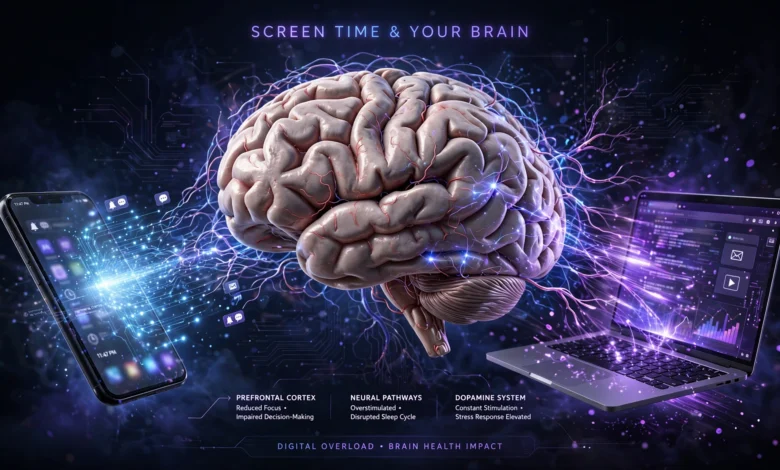
Most of us pick up our phones before we even get out of bed. By the time the day ends, we’ve scrolled, streamed, texted, and stared at screens for hours without giving it a second thought. But screen time and your brain have a more complicated relationship than most people assume, and the science on it has been piling up fast.
This isn’t about guilt-tripping anyone into throwing their phone in a lake. Screens aren’t going anywhere, and honestly, they make a lot of things easier. The real question is what happens inside your head when you spend six, eight, or ten hours a day staring at a rectangle of light, and whether there’s anything you can actually do about it.
Researchers studying screen time effects on the brain have found links to changes in attention span, memory, sleep quality, and even brain structure itself, especially in kids and teens whose brains are still developing. Adults aren’t off the hook either. Studies on adult screen habits point to thinning in parts of the cortex tied to learning and decision-making.
In this article, we’ll walk through what’s actually happening in your brain when you’re glued to a screen, what the research says about long-term risks, and what you can realistically do to protect your brain health without pretending it’s 1995 again.
What Happens to Your Brain During Screen Time
Every time you look at a screen, your brain is doing a lot more work than it seems. Notifications, autoplay videos, infinite scroll feeds, and bright colors are all engineered to keep your attention locked in, and your brain responds to that stimulation in predictable ways.
Dopamine and the Reward Loop
Apps and platforms are built around a simple mechanism: unpredictable rewards. A like, a comment, a new video, a match on a dating app. Your brain releases small hits of dopamine each time something new or interesting shows up, which is the same reward chemical involved in other habit-forming behaviors. Over time, this can train your brain to crave that quick hit of novelty, making it harder to sit still with a book, a conversation, or your own thoughts.
Attention and Focus Take a Hit
Screen time and attention span are closely linked, and not in a good way. Constant switching between apps, tabs, and notifications trains your brain toward shorter bursts of focus rather than sustained concentration. Researchers refer to this as “task-switching,” and each switch comes with a small mental cost. Do it enough times a day, and it adds up to a brain that struggles with deep, uninterrupted work.


Memory Formation Changes
When you know information is one search away, your brain doesn’t always bother encoding it the way it used to. This is sometimes called the “Google effect,” and while it’s not necessarily harmful on its own, combined with heavy digital media consumption, it can shift how your brain prioritizes what’s worth remembering versus what’s worth outsourcing.
The Research on Screen Time and Brain Development
A good chunk of the concern around screen time and brain development comes from studies on children and teenagers, whose brains are undergoing rapid structural changes well into their twenties.
Researchers at Zhejiang University, publishing in the journal Advanced Science, found a trade-off between heavy device use and cognition, behavior, and brain volume in children and adolescents. The lead researcher on that study noted that when kids invest large amounts of time in screens, it often comes at the expense of reading, physical activity, and sleep, all of which matter for healthy brain development.
A separate MRI study out of Cincinnati Children’s, published in Scientific Reports, scanned the brains of healthy children aged 3 to 5 and found associations between higher screen use and differences in brain structure, including lower white-matter integrity linked to early literacy skills. An earlier study from the same research group had already connected higher screen usage in preschoolers to measurable differences in brain white matter.
Some key findings from the broader body of research on kids and teens include:
- Reduced executive function in children with higher screen time, even after accounting for verbal ability
- Impaired reciprocal communication and emotional regulation linked to excessive passive screen use in early childhood
- Poorer performance on developmental screening tests among toddlers with elevated screen exposure at ages 2 and 3
- Displacement of physical activity, which researchers have linked to changes in intracranial volume and, in turn, cognitive outcomes
None of this means every child who watches videos on a tablet is doomed. Researchers studying this area are consistent about one thing: the data is still evolving, much of it relies on self-reported habits, and effect sizes tend to be small. But the direction of the evidence is hard to ignore, and it’s enough that pediatric health organizations recommend limits on recreational screen time for younger children.
How Screen Time Affects the Adult Brain
It’s tempting to think of this as a kids’ issue, but screen time and the adult brain is its own growing area of research. A study highlighted by Stanford’s Lifestyle Medicine program found that excessive screen time in adults, defined as more than two hours a day outside of work, was associated with thinning of the cerebral cortex in young adults aged 18 to 25. That’s the outer layer of the brain responsible for memory, language, and decision-making.
According to Maris Loeffler, a family and marriage therapist affiliated with Stanford’s Cognitive Enhancement program, the tricky part about screen exposure is that the damage isn’t visible in the moment. You don’t feel your cortex thinning while you’re watching another video, which makes it easy to underestimate the cumulative effect of years of heavy use.
Adults dealing with high screen time exposure commonly report:
- Difficulty concentrating on long-form reading or complex tasks
- Increased eye strain, headaches, and neck or shoulder tension
- Disrupted sleep patterns, particularly with screen use close to bedtime
- Lower tolerance for boredom or downtime without stimulation
- Reduced face-to-face social interaction over time
The eye-brain connection is part of this too. Since the eyes send information directly to the brain, prolonged visual strain from screens can contribute to fatigue that extends beyond just tired eyes. The American Academy of Ophthalmology recommends the 20-20-20 rule for people working on computers: every 20 minutes, look at something roughly 20 feet away for 20 seconds. It’s a small habit, but it gives both your eyes and your brain a genuine break from constant near-focus.
Screen Time, Sleep, and Mental Health
One of the most consistent findings across screen time research involves sleep. Blue light from screens can suppress melatonin production, the hormone your body uses to signal that it’s time to wind down. Scrolling in bed doesn’t just delay sleep, it can also reduce the quality of the sleep you do get, which has knock-on effects for memory consolidation, mood regulation, and next-day focus.
A large longitudinal analysis using data from the Adolescent Brain Cognitive Development (ABCD) Study followed thousands of adolescents in the United States and examined the relationship between screen time and mental health. The researchers noted that increased screen-based technology use has been hypothesized to contribute to rising rates of mental health concerns among teenagers, and that screen time among this age group rose sharply during the pandemic. On average, kids aged 8 to 12 in the study spent around 5.5 hours a day on screens outside of schoolwork, while teens aged 13 to 18 spent closer to 8.5 hours a day.
The study’s authors were careful to note limitations, including reliance on self-reported data, which can introduce bias. Still, the association between heavy screen use and outcomes like anxiety, low mood, and behavioral difficulties has shown up across multiple studies, even if the size of the effect varies.
You can read more about the ABCD Study’s findings directly through the National Institutes of Health’s research archive, which offers a detailed breakdown of the methodology and results.
Signs Your Brain Might Need a Screen Time Reset
Not everyone experiences the same symptoms, but there are a few common signs that your digital habits might be catching up with you:
- You reach for your phone automatically, without deciding to
- You feel restless or anxious when you’re without your device for more than a few minutes
- Reading a full article or book feels harder than it used to
- Your sleep feels lighter or less refreshing than it should
- You notice more eye strain, headaches, or tension by the end of the day
- Conversations with people in the room feel less engaging than your feed
If a few of these sound familiar, it doesn’t mean something is fundamentally wrong. It usually just means your habits have drifted, and drifting habits can be redirected.
How to Protect Your Brain From Too Much Screen Time
The goal here isn’t zero screens. That’s not realistic for most people, and it’s not even necessary. The goal is protecting your brain while still getting the benefits screens genuinely offer. Here’s what actually tends to help.
1. Set Boundaries Around Bedtime
Keep screens out of the bedroom, or at minimum, stop using them 30 to 60 minutes before sleep. This gives melatonin production a chance to ramp back up naturally and improves the odds of falling asleep without a fight.
2. Use the 20-20-20 Rule
Every 20 minutes of screen work, look at something 20 feet away for 20 seconds. It’s a simple habit recommended by eye health professionals, and it doubles as a quick mental reset during long work sessions.
3. Build in Screen-Free Blocks
Pick specific windows of your day, meals, the first 30 minutes after waking, or a walk after work, and keep them screen-free. These small pockets give your brain a chance to process information without constant new input.
4. Turn Off Non-Essential Notifications
Every notification is a small interruption competing for your attention. Turning off anything that isn’t genuinely time-sensitive reduces the number of times your brain has to switch gears throughout the day.
5. Prioritize Physical Activity
Physical activity has repeatedly been shown to counterbalance some of the negative outcomes tied to sedentary screen use, particularly in children and teens. Even short bouts of movement can help offset long stretches of sitting in front of a screen.
6. Practice Single-Tasking
Rather than keeping five tabs and three apps open, try working through one task at a time. This rebuilds the kind of sustained attention that heavy multitasking tends to erode.
7. Get Outside, Literally
Natural light exposure during the day helps regulate your circadian rhythm, which supports both sleep and mood. It also gives your eyes a break from the fixed, close-up focus that screens demand.
8. Model Healthy Habits for Kids
If you’re a parent, your own screen habits matter as much as the rules you set. Children pick up on behavior more than instructions, so demonstrating balanced screen use tends to be more effective than restrictions alone.
For families looking for more structured guidance, the American Academy of Pediatrics and other health organizations publish age-based screen time recommendations that can serve as a useful starting point, though every household’s situation is different.
Finding a Sustainable Balance
The relationship between screen time and your brain isn’t a simple story of good versus bad. Screens support learning, connection, and work in ways that weren’t possible a generation ago. At the same time, the research is increasingly clear that unmanaged, excessive use carries real costs, from changes in attention and memory to measurable differences in brain structure, particularly during childhood and adolescence.
The most useful approach isn’t an all-or-nothing rule. It’s paying attention to how you actually feel after a long stretch of screen use, noticing patterns like disrupted sleep or shortened attention span, and making small, sustainable adjustments rather than dramatic overhauls that rarely stick.
Brain health, like most health, responds better to consistent small habits than to occasional extreme resets. A few boundaries around bedtime, regular breaks, and time spent away from screens each day can go a long way toward protecting the brain function that heavy, unbroken screen use tends to chip away at.
Conclusion
Screen time and your brain are more connected than most people realize, with research linking heavy or unmanaged use to changes in attention, memory, sleep, and even brain structure in both children and adults.
The good news is that protecting your brain doesn’t require cutting screens out entirely. Simple, consistent habits, like setting bedtime boundaries, taking regular visual breaks, staying physically active, and carving out screen-free time each day, can meaningfully reduce the risks while still letting you enjoy the real benefits technology has to offer.