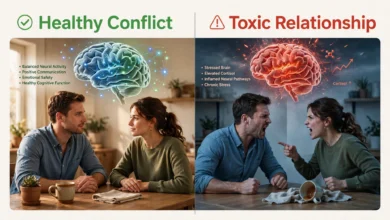
Healthy Conflict vs Toxic Relationship: 9 Powerful Warning Signs You Shouldn’t Ignore
Healthy conflict vs toxic relationship: how to tell normal arguments from harmful patterns, with 9 warning signs and practical ways to fight fair.

Healthy conflict vs toxic relationship is a question a lot of people ask quietly, usually late at night after another argument that didn’t go well. You love this person. You also fight. So which one is it: a normal couple working through normal friction, or something that is slowly wearing you down?
Here’s the thing most people get wrong. Arguing is not the problem. Every close relationship has disagreements, because two different people with different needs are trying to share a life. Couples who never fight often aren’t more connected. They are sometimes just avoiding the hard conversations.
What separates a strong couple from a struggling one is how the conflict happens and what it leaves behind. Healthy conflict ends with both people feeling heard, even if nothing is fully solved. A toxic relationship runs on a different pattern. The same fights repeat, one person feels small or scared, and repair rarely happens.
This guide breaks down the real difference between the two. You’ll see what fair fighting looks like, the signs of a toxic relationship that tend to hide in plain sight, why people confuse the two so easily, and what to do once you know where you stand. It isn’t meant to diagnose your partner. It’s meant to give you clearer language for what you’re living through, so you can make better decisions about it.
What Healthy Conflict in a Relationship Actually Looks Like
Healthy conflict in a relationship is a disagreement where both people stay on the same team, even while they want different things. It can be loud. It can be emotional. It can take a few rounds to settle. What makes it healthy is that respect stays intact and the goal is understanding, not winning.
The Core Traits of Healthy Conflict
When couples argue in a healthy way, a few things tend to show up again and again:
- The focus stays on the issue. You talk about the dishes, the money, or the missed call, not about what a terrible person your partner is.
- Both people get to speak. Each partner has room to explain their side without being talked over or dismissed.
- Feelings are allowed. Frustration, hurt, and disappointment can be named without punishment.
- There’s no fear. Neither person worries about being threatened, humiliated, or left if they speak up.
- Repair happens. Someone reaches out afterward with an apology, a joke, a hug, or a simple “can we try that again?”
Why Healthy Conflict Is Good for You
It sounds odd, but couples who know how to disagree well are often closer than couples who avoid conflict entirely. Working through a disagreement teaches you how your partner thinks, what they’re afraid of, and what they need. Each well-handled argument builds trust, because you both learn that the relationship can survive tension.


Healthy conflict also keeps resentment from piling up. Small issues get dealt with while they’re still small, instead of turning into silent grudges that explode months later.
Healthy Conflict Doesn’t Mean Perfect Conflict
Nobody fights fairly every single time. People snap, raise their voices, or say something they regret. A healthy relationship isn’t one where that never happens. It’s one where it’s the exception, and where the person who crossed a line owns it and tries to do better. The overall pattern matters more than any one bad night.
What Makes a Relationship Toxic?
A toxic relationship is one where harmful patterns repeat over time and leave at least one person feeling drained, anxious, or smaller than they used to be. The word gets thrown around a lot online, sometimes for any couple that argues. That’s not what it means. Toxicity is about the pattern, not the presence of conflict.
Patterns, Not Moments
One cruel comment during a heated fight doesn’t make a relationship toxic. The same cruel comment every week, with no apology and no change, starts to. In toxic relationship patterns, the bad moments aren’t isolated. They form a cycle that both people can usually predict.
Common toxic patterns include:
- Contempt: eye-rolling, mockery, sarcasm meant to wound, and treating your partner as beneath you.
- Control: deciding who you see, checking your phone, managing your money without your say, or making you ask permission for ordinary things.
- Manipulation: guilt-tripping, twisting your words, or gaslighting, where you’re made to doubt your own memory and judgment.
- Chronic blame: every problem is somehow your fault, and your partner rarely takes responsibility for anything.
- Emotional withdrawal as punishment: long silent treatments used to make you give in, rather than a short break to cool down.
How a Toxic Relationship Feels From the Inside
People in toxic relationships often describe the same feelings. They walk on eggshells. They rehearse conversations in their head before bringing anything up. They feel relief when their partner is in a good mood and dread when they aren’t. Over time their confidence drops and they start to wonder if they’re the problem.
That last part is important. Toxic dynamics are confusing on purpose, or at least in effect. If you constantly feel like you’re failing a test you don’t understand, that feeling itself is information.
Toxic vs. Abusive: An Important Line
Not every toxic relationship is abusive, but the two overlap. Emotional abuse and physical abuse are built around power and control, with one person working to dominate the other. That’s different from two people who both communicate badly. If you feel afraid of your partner, are being threatened, or are being hurt physically or sexually, this is no longer a communication problem. Your safety comes first, and the help section later in this article applies to you.
Healthy Conflict vs Toxic Relationship: The Key Differences
When you compare healthy conflict vs toxic relationship dynamics side by side, the gap becomes much easier to see. The topics of the fights might be identical. The way they unfold is not.
| What to look at | Healthy conflict | Toxic relationship |
|---|---|---|
| Goal of the argument | Understanding and solving the problem | Winning, punishing, or proving a point |
| Tone | Frustrated but respectful | Contemptuous, mocking, or threatening |
| Topic | Stays on the issue at hand | Drifts into character attacks and old wounds |
| Listening | Both people feel heard | One person is ignored or talked over |
| After the fight | Repair, apology, reconnection | Silence, coldness, or the fight is denied |
| Responsibility | Shared and owned | Always shifted to one person |
| Safety | You can speak freely | You edit yourself out of fear |
| Pattern over time | Issues get resolved or managed | Same fight repeats with no change |
Relationship researcher John Gottman spent decades studying couples in conflict. His team identified four behaviors that strongly predict a relationship will fail: criticism, contempt, defensiveness, and stonewalling. You can read more about these in the Gottman Institute’s guide to the Four Horsemen of relationship conflict. When those four show up constantly, conflict has usually crossed from healthy into harmful.
9 Warning Signs Your Conflict Has Turned Toxic
These are the relationship red flags that tend to separate a rough patch from a damaging pattern. One sign on its own isn’t proof of anything. Several of them showing up together, and repeating, is worth taking seriously.
1. Arguments Become Personal Attacks
In healthy conflict you say “I was hurt when you forgot.” In toxic conflict it becomes “You’re so selfish, you never think about anyone.” Once the target shifts from the behavior to the person, the fight stops being about solving anything.
2. Contempt Shows Up Regularly
Contempt is treating your partner with disgust or superiority. Think sneering, name-calling, or mocking their feelings. Gottman’s research found contempt to be the single strongest predictor of breakup, because it communicates that one partner doesn’t respect the other at all.
3. You Feel Afraid to Bring Things Up
If you hold back concerns because you know they’ll lead to an explosion, a punishment, or days of coldness, that’s a serious sign. Healthy communication requires that both people feel safe enough to be honest.
4. The Same Fight Never Gets Resolved
All couples have a few recurring disagreements. The difference is whether you make any progress. In a toxic relationship, the same argument loops endlessly and nothing changes, because one or both people aren’t actually trying to fix it.
5. Your Reality Gets Rewritten
You remember something clearly, and your partner insists it never happened, or that you’re overreacting, or that you’re “crazy.” When this happens often, it’s called gaslighting, and it slowly wears down your trust in yourself.
6. Silence Is Used as a Weapon
Taking 20 minutes to cool off is healthy. Ignoring your partner for days until they apologize for something they didn’t do is not. The silent treatment used as punishment is a form of control.
7. Blame Only Flows One Way
In a healthy relationship both people can say “I got that wrong.” When one person never admits fault and always finds a way to make you responsible, conflict becomes a trial where you’re always the defendant.
8. Apologies Don’t Lead to Change
Some toxic relationships do have apologies, sometimes very emotional ones. But if the same harmful behavior returns again and again, the apology was about ending the discomfort, not about changing anything.
9. You Don’t Recognize Yourself Anymore
Maybe you used to be confident, social, and relaxed. Now you’re anxious, isolated, and second-guessing everything. When a relationship consistently makes you a smaller version of yourself, that’s one of the clearest signs of a toxic relationship there is.
Why People Confuse Healthy Conflict and Toxic Relationship Patterns
If the difference is this clear on paper, why is it so hard to see in real life? Because when you’re inside a relationship, you’re not reading a comparison table. You’re dealing with love, history, habit, and hope all at once.
Reasons the Line Gets Blurry
- What you grew up with feels normal. If your parents screamed at each other or went silent for days, those patterns can feel like ordinary relationship behavior, even when they aren’t.
- The good times are real. Toxic relationships usually aren’t bad all the time. Warm, loving stretches make it easy to dismiss the painful ones as exceptions.
- Pop culture romanticizes drama. Jealousy, intense fights, and dramatic makeups get presented as proof of passion. In real life they’re often signs of instability.
- Self-blame creeps in. When you’re told repeatedly that you’re too sensitive, you start to believe it and stop trusting your own read on the situation.
- The change is gradual. Toxic patterns rarely start on day one. They build slowly, so each step feels like only a small shift from the last.
The Opposite Mistake: Calling Every Fight Toxic
The confusion goes both ways. Some people label any argument as toxic and assume a good relationship should feel calm all the time. That belief can push you to avoid conflict entirely, which creates its own problems.
A partner who disagrees with you, sets a boundary, or tells you they’re upset isn’t being toxic. They’re being honest. Healthy relationship boundaries sometimes feel uncomfortable, especially at first. Discomfort and harm are not the same thing.
A Simple Question That Helps
When you’re unsure, ask yourself this: after our fights, do I generally feel closer to my partner and more understood, or more alone and more afraid? Your honest answer, looked at across months rather than one evening, will tell you a lot.
How to Fight Fair: Turning Conflict Into Growth
If your relationship sits on the healthy side of the line but your arguments still feel messy, the good news is that conflict resolution in relationships is a skill. You can get better at it. These steps work best when both partners are willing to try.
1. Start Gently
How a conversation begins often decides how it ends. Open with how you feel and what you need, not with an accusation. “I’ve been feeling disconnected lately and I miss our evenings together” lands very differently from “You never make time for me.”
2. Use “I” Statements
Talk about your experience instead of diagnosing your partner. “I felt embarrassed when that came up in front of your friends” invites a conversation. “You humiliated me on purpose” invites a defense.
3. Stick to One Issue
It’s tempting to bring up every past grievance once you’re upset. Resist it. Pick the one thing you’re actually discussing and stay with it. Old issues deserve their own conversations.
4. Listen to Understand
Before you respond, try repeating back what you heard: “So you’re saying you felt left out when I made plans without asking?” This one habit lowers the temperature fast, because people calm down when they feel understood.
5. Take Breaks the Right Way
When your heart is racing and you can’t think straight, step away. Say clearly that you’re taking a break and when you’ll come back, for example “I need 30 minutes, then let’s keep talking.” That’s different from storming off or going silent with no end in sight.
6. Look for Compromise, Not Victory
Ask “what would work for both of us?” instead of “how do I get my way?” Many recurring arguments aren’t fully solvable. They come from real differences in personality or values. The aim with those is to manage them kindly, not to make them disappear.
7. Repair Quickly
After a fight, reach back toward each other. An apology, a touch, a cup of tea, or “I’m sorry I got so sharp with you” all count. Couples who repair well don’t stay stuck in resentment.
Can a Toxic Relationship Become Healthy?
Sometimes, yes, but only under specific conditions. Both people need to see the problem, take responsibility for their part, and keep changing their behavior over time, not just for a week. Couples therapy can help a lot here. If only one person is doing the work, or if there’s abuse involved, the outlook is very different. Abuse is not fixed by better communication skills, and couples counseling is generally not recommended when one partner is being abused.
When to Get Help or Walk Away From a Toxic Relationship
Recognizing a toxic relationship is one step. Deciding what to do about it is harder, and there’s no single right answer for everyone. What matters is that you make the choice with clear eyes and real support.
Signs It’s Time to Talk to a Professional
Consider reaching out to a licensed therapist or counselor if:
- Your arguments keep escalating and you can’t break the cycle on your own.
- You feel anxious, depressed, or numb most of the time.
- You’ve lost touch with friends or family since the relationship started.
- You honestly can’t tell anymore whether your reactions are reasonable.
- You want to stay and work on things but don’t know where to start.
Individual therapy can be especially useful, because it gives you a space that belongs only to you. A good therapist won’t tell you what to do. They’ll help you see the situation more clearly so you can decide for yourself.
When Safety Is the Priority
Some situations go beyond toxic and into abuse. Treat these as urgent:
- Your partner has hit, pushed, choked, or physically hurt you.
- You’ve been threatened, including threats to harm themselves, you, your kids, or your pets.
- You’re being forced or pressured into sexual acts.
- Your partner controls your money, phone, or movements to the point that you feel trapped.
- You’re genuinely afraid of what they’ll do if you leave.
If any of these apply, a domestic violence service can help you build a safety plan, even if you’re not ready to leave yet. In the United States, the National Domestic Violence Hotline offers free, confidential support by phone, text, and chat. Outside the US, local women’s shelters, family protection units, and national helplines offer similar support. If you’re in immediate danger, contact your local emergency number.
Leaving Is a Process
If you decide to end the relationship, be gentle with yourself. Many people leave and return several times before it sticks, and that’s not a failure. Lean on the people who care about you, keep records if there’s been abuse, and plan the practical details ahead of time when you can. Walking away from something that hurts you is one of the most self-respecting choices a person can make.
Conclusion
The difference in healthy conflict vs toxic relationship dynamics comes down to respect, safety, and repair. Healthy couples still argue, sometimes loudly, but they stay on the same team, keep the focus on the problem, and find their way back to each other afterward.
Toxic relationships run on repeated contempt, control, blame, and fear, and they leave one or both people feeling smaller over time. If your fights mostly bring you closer, keep building your conflict skills with gentler starts, honest listening, and quick repair. If they mostly leave you anxious, isolated, or doubting yourself, take that seriously, talk to someone you trust or a professional, and put your safety and well-being first.