How to Build Self-Discipline When Motivation Runs- Out
Self-discipline fades when motivation disappears. Here are seven practical strategies to build lasting consistency and follow through.

Self-discipline is the thing everyone wants and almost nobody trusts they have enough of. You start a new routine full of energy, and for a week or two it feels effortless. Then the initial excitement fades, life gets busy, and suddenly the gym bag stays zipped and the manuscript stays half-written. This is the point where most people quietly give up and tell themselves they just aren’t disciplined people. That story is almost never true. What actually happened is that motivation, which is an emotional state, ran out, and nothing was built underneath it to keep you moving.
The good news is that self-discipline isn’t a personality trait you’re born with. It’s closer to a skill, built the same way you’d build any other one: through repetition, structure, and a few honest adjustments when things stop working. This article breaks down why motivation is so unreliable in the first place, and walks through seven grounded, practical ways to keep showing up even when you don’t feel like it. None of this requires a personality transplant or a 4 a.m. wake-up call. It just requires understanding how discipline actually works, and building a few habits that make it easier to act, even on the days your motivation has nothing to offer you.
What Self-Discipline Really Means (and Why Motivation Isn’t Enough)
Motivation and self-discipline get used interchangeably, but they’re not the same thing, and confusing them is where most people go wrong.
Motivation is a feeling. It’s the spark you get from a good podcast, a milestone birthday, or a photo of your future self looking fit and successful. It’s real, but it’s also short-lived by nature. Feelings shift with your mood, your sleep, your stress levels, and the weather, honestly. You can’t schedule a feeling to show up reliably at 6 a.m. every Monday.
Self-discipline, on the other hand, is behavioral. It’s the ability to act in line with your goals and values regardless of how you feel in the moment. Discipline doesn’t ask “do I feel like doing this today?” It asks “does this move me toward the person I’m trying to become?” That distinction matters because it changes what you should actually be working on. You’re not trying to manufacture more motivation. You’re trying to build habits, systems, and small routines that don’t depend on motivation to function.
Psychologists who study self-control describe it as a limited but trainable resource, similar to a muscle that gets stronger with consistent use but tires with overuse in a single stretch. That’s part of why willpower alone is such a fragile strategy: it’s finite on any given day, and it depletes faster under stress. The American Psychological Association’s research on self-control points to the same conclusion many discipline coaches have landed on through trial and error: building routines and reducing decision fatigue works better long-term than relying on raw willpower alone.
Why Motivation Runs Out So Fast
Before you can fix the problem, it helps to understand why motivation is such an unreliable engine in the first place.


- It’s tied to emotion, not commitment. Motivation rises and falls with how you’re feeling that day, which means it’s completely at the mercy of sleep, stress, and mood.
- It fades with familiarity. The excitement of something new naturally wears off once the novelty is gone, even if the goal still matters to you.
- It doesn’t survive friction. The moment a task requires effort, planning, or discomfort, motivation tends to disappear and excuses show up to fill the gap.
- It’s reactive, not proactive. Motivation usually shows up after you’ve already started something, not before, which is why waiting to “feel ready” is often the very thing that stalls people out.
This is why relying purely on motivation to build self-discipline sets people up to fail. It’s not a character flaw. It’s simply the wrong tool for a job that requires consistency.
How to Build Self-Discipline: 7 Practical Strategies
Building discipline isn’t about forcing yourself through sheer grit every single day. It’s about designing your habits, environment, and expectations so that showing up requires less internal negotiation. Here are seven strategies that hold up even when motivation has completely checked out.
1. Start Ridiculously Small
One of the biggest reasons people abandon new habits is that they aim too high, too fast. A goal like “work out for an hour every day” sounds ambitious, but it’s also exhausting to even think about on a low-energy day, so it gets skipped entirely.
Instead, shrink the commitment until it feels almost too easy to say no to. Two push-ups. One paragraph. Five minutes of practice. The point isn’t the output of that single session; it’s proving to yourself, over and over, that you’re someone who follows through. Small, consistent wins build behavioral evidence, and that evidence compounds into real discipline over weeks and months.
2. Build Systems, Not Just Goals
Goals tell you where you want to end up. Systems tell you what you’ll actually do on a Tuesday when nothing exciting is happening. Without a system, discipline collapses the moment motivation dips, because there’s nothing left to lean on.
A useful system includes:
- A specific time and place for the habit, not a vague “sometime today”
- A clear trigger that kicks off the behavior (after coffee, before checking your phone, right after work)
- A minimum viable version of the task for low-energy days
- A way to track whether you actually did it
Self-discipline grows faster when you’re not relying on daily decisions. When the system already tells you what to do, you conserve the mental energy that would otherwise go into arguing with yourself.
3. Remove Friction From Good Choices
Discipline isn’t really about constant self-control in the moment. It’s about making the good choice the easier choice before you even get there. If your phone is sitting next to your desk, you’ll eventually pick it up mid-task, not because you’re weak, but because willpower is limited and proximity wins.
Some practical ways to reduce friction:
- Lay out your workout clothes the night before
- Keep your laptop closed to the exact document you need to work on
- Delete or log out of distracting apps during focused work blocks
- Keep unhealthy snacks out of easy reach, and healthy ones visible
The goal isn’t to fight temptation head-on every time. It’s to reduce how often you’re forced to fight it at all.
4. Use the Two-Minute Rule to Beat Resistance
Resistance to a task is almost always strongest right before you start, not once you’re actually doing it. Your brain treats the beginning of any effortful activity as a major decision point, which is why staring at a blank page or a closed gym door feels so much harder than the actual work once you’re in it.
The fix is a simple commitment: work on the task for just two minutes, with permission to stop after that if you truly want to. In practice, most people find that once they’re a couple of minutes in, the resistance drops off and they keep going far past the two-minute mark. This trick works because it lowers the barrier to starting, and starting is usually the entire battle.
5. Track Your Progress Visibly
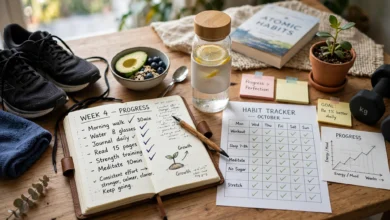
Goals that live only in your head are easy to quietly abandon. Nobody notices, including you, until weeks have passed. But when progress is visible, whether it’s a habit tracker, a calendar with X’s marked on it, or a simple checklist, something shifts. You start showing up differently because the gaps become impossible to ignore.
Visible tracking also gives you something motivation never will: objective proof of consistency. On the days you feel like you’ve made zero progress, a habit tracker filled with checkmarks tells a more accurate story than your mood does.
6. Build in Accountability
Self-discipline grows faster when you’re not doing it entirely alone. Telling a friend about your goal, joining a group with a shared target, or simply reporting your progress to someone else adds a layer of commitment that’s harder to quietly walk away from than a private New Year’s resolution.
This doesn’t require a formal accountability partner or an expensive coach. It can be as simple as:
- A weekly check-in text with a friend working toward a similar goal
- A shared spreadsheet where you both log progress
- Posting your goal somewhere you’ll have to explain it if you quit
The National Institutes of Health has published research on how social support influences health behavior change, and the pattern holds up well outside of health goals too: people who feel observed and supported are more likely to follow through than those going it entirely alone.
7. Reconnect With Your Identity, Not Just the Outcome
Vague goals drain discipline faster than almost anything else. “I’ll work out more” or “I’ll be more productive” creates hesitation because there’s no clear finish line and no clear next action. Discipline holds up better when it’s tied to identity rather than outcome.
Instead of framing your goal purely around results, ask what kind of person follows through on this. “I’m someone who shows up for my workouts, even short ones” is a more durable motivator than “I want to lose fifteen pounds,” because identity-based goals survive bad weeks. The outcome might be delayed by illness, travel, or a rough patch, but the identity doesn’t have to be.
What to Do on the Days You Truly Don’t Feel Like It
Even with strong systems in place, there will be days where none of it feels like enough. On those days:
- Lower the bar, don’t cancel the habit. Do the two-minute version instead of skipping entirely.
- Remember your why, briefly. A quick reconnection to the reason you started, without turning it into a guilt spiral.
- Separate the feeling from the action. You don’t need to feel ready to begin. Feeling ready is often a result of starting, not a requirement for it.
- Take an actual break when you need one. Discipline isn’t about running yourself into the ground. Built-in rest prevents the burnout that derails consistency far more than the occasional off day does.
Common Mistakes That Undermine Self-Discipline
A lot of people are working harder than they need to because of a few avoidable habits:
- All-or-nothing thinking. Missing one day doesn’t erase your progress, but treating it like a failure often turns one missed day into a missed month.
- Relying on inspiration to get started. Waiting to feel motivated before beginning almost guarantees long gaps between attempts.
- Setting goals with no clear system behind them. A goal without a plan is just a wish with a deadline attached.
- Ignoring environment. Trying to out-willpower a distracting environment is exhausting and usually loses.
- Punishing yourself for setbacks. Shame rarely produces consistency. It usually produces avoidance instead.
How Long Does It Take to Build Self-Discipline?
There’s no universal number, no matter what a headline promises you. What research and practical experience both suggest is that habits become more automatic somewhere in the range of a few weeks to a couple of months of consistent repetition, depending on the complexity of the behavior and how disruptive your environment is. The more important point is that self-discipline isn’t a switch that flips on permanently. It’s a skill you keep reinforcing, the same way physical strength fades if you stop training it. Progress isn’t linear, and that’s normal. What matters is the direction of the trend, not the perfection of every single day.
Conclusion
Motivation was never designed to carry you all the way to your goals, and expecting it to is where most people quietly get stuck. Self-discipline works differently. It’s built through small, repeatable actions, systems that don’t depend on how you feel that day, an environment that makes good choices easier, and a bit of accountability to keep you honest.
None of the seven strategies above require dramatic willpower or a complete personality overhaul. They just require starting small, tracking your progress, and treating discipline as a skill you’re training rather than a trait you either have or don’t. On the days motivation disappears entirely, and it will, the systems you’ve built are what keep you moving forward anyway.