The Science Behind Self-Improvement That Actually Works
Self-improvement that actually works starts with brain science, not willpower. Here's what research says really drives lasting change.
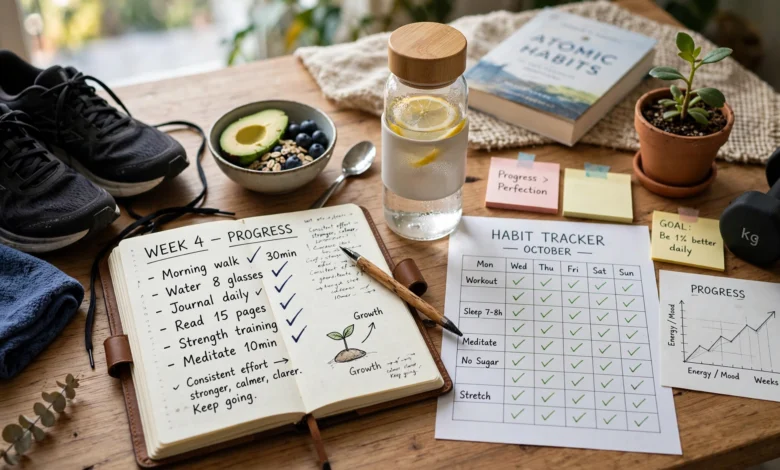
Self-improvement is one of the most searched, most sold, and most misunderstood topics online. Everyone has a system. Everyone has a five-step morning routine or a “life-changing” book they want to sell you. But most of it ignores a simple fact: the brain doesn’t change because you read a quote on Instagram. It changes because of specific, repeatable processes that neuroscience and psychology have been studying for decades.
This article isn’t another list of vague affirmations. It’s a breakdown of what actually happens in your brain and behavior when change sticks, based on research from psychologists, neuroscientists, and behavioral scientists. We’ll look at why willpower alone almost always fails, how long habits really take to form, what neuroplasticity means in practical terms, and seven strategies backed by real studies rather than motivational posters.
If you’ve tried to build better habits before and quietly given up around week two, you’re not lacking discipline. You were probably using a method that was never designed to survive contact with real life. The good news is that self-improvement that actually works isn’t about trying harder. It’s about working with how your brain is already wired, instead of fighting it. Let’s get into the science.
What the Research Actually Says About Self-Improvement
Most self-help advice treats change as a matter of motivation. Want it badly enough, and you’ll get there. Research tells a different story. Motivation is unreliable by nature. It spikes when you set a goal and fades within days, long before a new behavior has had time to become automatic.
What separates people who successfully change their habits from those who don’t isn’t grit or intensity. It’s structure. Studies on behavior change consistently point to a few recurring factors:
- Small, specific actions succeed more often than big, vague goals
- Environment shapes behavior more than intention does
- Consistency matters more than perfection
- Identity-based change outlasts outcome-based change
None of this is glamorous, which is probably why it gets less attention than “10 Habits of Highly Successful People” listicles. But it’s what the data actually supports.
The Habit Loop: How Your Brain Builds Automatic Behavior
To understand self-improvement, you first need to understand how habits form at a mechanical level. Researchers, including those who popularized the concept through MIT studies, describe habit formation as a loop made up of three or four parts: a cue, a craving or routine, a response, and a reward.


Here’s how it plays through in practice:
- Cue – something triggers the behavior, like your alarm going off or feeling stressed after a long meeting
- Craving or routine – your brain anticipates a specific outcome and initiates the action
- Response – you perform the behavior itself
- Reward – you get a payoff, which reinforces the loop and makes it more likely to repeat
Over time, this loop moves from something your prefrontal cortex has to actively manage to something stored in the basal ganglia, a much older part of the brain responsible for automatic behavior. This is why an established habit, good or bad, feels effortless while a new one feels like a constant uphill fight. Your brain hasn’t filed it away as “automatic” yet.
This also explains why roughly 40 to 45 percent of daily actions aren’t conscious decisions at all. They’re habits running quietly in the background. If you want lasting self-improvement, the goal isn’t to rely on conscious effort forever. It’s to get a new behavior into that automatic category as quickly as possible.
Why Willpower Isn’t the Answer (And What Is)
Willpower gets treated like a personality trait, something you either have or don’t. But psychologists increasingly view it as a limited resource that fluctuates throughout the day, influenced by sleep, stress, and even blood sugar. Relying on willpower alone to build new habits is a bit like trying to charge your phone with a battery that’s already running low.
A longitudinal study on habit formation examined how self-control capacity influenced people trying to build new habits over 90 days, tracking behaviors like exercise, healthy eating, and saving money. The surprising finding was that self-control didn’t meaningfully predict who succeeded. What mattered more was consistent repetition of the behavior itself. You can read more about this in the longitudinal field study on self-control and habit formation published on PubMed Central.
In other words, effective self-improvement isn’t about summoning more discipline. It’s about designing your routine so you need less of it. That means:
- Reducing friction for behaviors you want to build
- Increasing friction for behaviors you want to drop
- Relying on environment and systems instead of memory or mood
- Accepting that early repetitions will feel effortful, and that’s normal
The Science of Habit Formation Timelines
One of the most repeated claims in self-help content is that it takes 21 days to form a habit. It’s catchy, but it isn’t accurate. The number actually comes from a 1960s plastic surgeon’s observations about patients adjusting to physical changes, not a controlled study on habit formation.
A more rigorous look at the question came from researchers at University College London, who tracked participants building simple habits like drinking water or eating fruit daily. On average, habit formation took around 66 days to reach automaticity. But the range was wide. Some participants got there in as little as 18 days, while others needed upwards of 254 days depending on the complexity of the behavior and individual differences.
The takeaway here matters more than the exact number: struggling with a new habit at day 20 doesn’t mean the habit has failed. It usually just means you haven’t hit enough repetitions yet. Judging your progress against an arbitrary 21-day deadline sets you up to quit right before the habit would have started feeling automatic.
Neuroplasticity: Rewiring Your Brain for Change
Neuroplasticity is the brain’s ability to reorganize itself by forming new neural connections throughout life. It’s the biological mechanism that makes any form of learning or habit change possible in the first place. Without it, self-improvement wouldn’t just be difficult. It would be biologically impossible.
Neuroplasticity happens in two ways:
- Passively, through repeated behavior and experience over time
- Actively, when you deliberately practice a new skill or habit with focused attention
The second type, sometimes called self-directed neuroplasticity, is where intentional self-improvement lives. When you consciously choose to repeat a behavior in a specific context, you’re not just building a habit in the abstract. You’re physically strengthening the neural pathways associated with that behavior, while the pathways tied to old patterns weaken from lack of use.
This is why context matters so much. Practicing a new habit in the same place, at the same time, in response to the same cue speeds up the rewiring process. Scattered, inconsistent practice slows it down, even if the total effort is the same.
For a deeper look at how the brain physically restructures itself through learning and repetition, the research summary on the neuroscience of habit formation from Simply Psychology is a solid, well-sourced starting point.
7 Evidence-Based Strategies for Self-Improvement That Actually Works
Here’s where the science translates into action. These seven strategies are drawn directly from behavioral research rather than generic advice.
1. Start Smaller Than Feels Necessary
The most common reason new habits fail isn’t lack of motivation. It’s setting the bar too high on day one. Behavioral researchers have found that scaling a habit down to something almost laughably easy, like doing two push-ups instead of thirty, dramatically increases the odds you’ll actually do it. Once the behavior becomes automatic, intensity and duration can increase naturally.
2. Anchor New Habits to Existing Routines
Habit stacking, or attaching a new behavior to one you already do consistently, works because it borrows an existing cue instead of requiring you to remember a new one. For example, “after I pour my morning coffee, I’ll write down three priorities for the day” uses coffee as a built-in trigger.
3. Change Your Environment, Not Just Your Intentions
Willpower fades. Environment doesn’t. Keeping healthy snacks visible and junk food out of sight, or placing your workout clothes next to your bed, removes the decision-making step where most habits break down. Design your surroundings so the desired behavior is the path of least resistance.
4. Track Behavior, Not Just Outcomes
Weighing yourself daily or checking a bank balance obsessively measures outcomes, which are influenced by many factors outside your control. Tracking the behavior itself, like whether you exercised or whether you logged your spending, gives you a more direct and motivating signal of progress.
5. Use Addition Before Subtraction
Research on nutrition and lifestyle habits shows that adding a positive behavior, like one extra serving of vegetables, tends to stick better than eliminating a favorite food outright. Restriction often triggers psychological reactance, where people rebel against the very rule they set for themselves. Build up before you cut down.
6. Expect and Plan for Missed Days
Consistency doesn’t mean perfection. Studies on habit strength show that missing a single day here or there has little effect on long-term habit formation, as long as the behavior resumes soon after. The real danger isn’t one missed day. It’s the shame spiral that turns one missed day into an abandoned habit.
7. Tie the Habit to Identity, Not Just Goals
Wanting to “run a marathon” is an outcome-based goal. Wanting to “become a runner” is identity-based. Research on behavior change suggests identity-based habits are more durable because every time you perform the behavior, you’re casting a vote for the kind of person you want to be, which reinforces motivation independent of results.
Common Mistakes That Sabotage Self-Improvement Efforts
Even well-intentioned attempts at self-improvement tend to fail for a handful of predictable reasons:
- Trying to change too much at once. Overhauling diet, exercise, sleep, and screen time simultaneously overwhelms your limited capacity for self-regulation.
- Relying on motivation instead of systems. Motivation is a mood, not a strategy. Systems don’t care how you feel that day.
- Ignoring recovery and sleep. Poor sleep directly reduces self-control and impulse regulation, making every other habit harder to maintain.
- Comparing your timeline to someone else’s. Since habit formation can take anywhere from 18 to 254 days, comparing your week-three struggle to someone else’s highlight reel is comparing apples to a completely different fruit.
- Treating setbacks as proof of failure. A missed workout or a skipped journal entry is data, not a verdict on your character.
How to Track Progress and Stay Consistent
Consistency is easier to maintain when progress is visible. A few practical, research-supported ways to do this:
- Use a simple habit tracker, whether that’s an app, a wall calendar, or a checkbox in a notebook
- Review your progress weekly instead of daily to avoid overreacting to normal fluctuations
- Pair new habits with a specific, consistent cue rather than “whenever I feel like it”
- Celebrate the repetition itself, not just the eventual outcome
- Reassess and adjust the habit if it consistently feels impossible rather than just uncomfortable
The American Psychological Association also covers this ground in its feature on how psychologists apply the science of habits to behavior change, which complements the studies referenced throughout this article.
Conclusion
Self-improvement that actually works isn’t built on inspiration, willpower, or arbitrary timelines like the 21-day myth. It’s built on understanding how your brain forms habits through the cue-routine-reward loop, how neuroplasticity allows those patterns to physically rewire over time, and how small, consistent, identity-aligned actions outperform big, dramatic overhauls.
The research is consistent: people who succeed at lasting change aren’t more disciplined than everyone else. They simply design their environment, expectations, and routines around how behavior change actually works, rather than how it’s often marketed. Start small, expect the process to take longer than 21 days, forgive the missed days, and let repetition do what motivation never could.