Self-Improvement Books That Actually Change How You Think
Self-improvement books can genuinely reshape your thinking. Here are the titles worth your time and why they actually work.
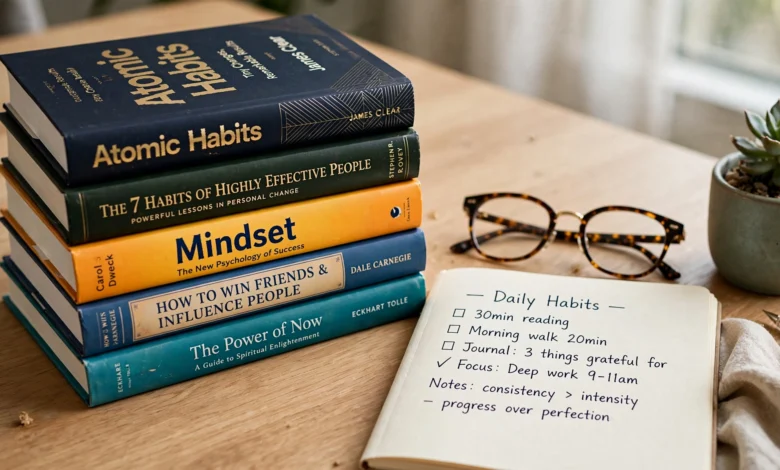
Walk into any bookstore and you’ll find a wall of self-improvement books promising to fix your life in thirty days or less. Most of them say the same thing in different words, and you forget the advice by the time you’re back in your car. But a small handful of books are different. They don’t just hand you a checklist. They change the actual wiring behind how you make decisions, handle setbacks, and see yourself.
This article isn’t another generic roundup. It’s a close look at the best self-improvement books that have held up over time, backed by psychology, behavioral science, and real reader results, not just marketing copy. I’ll walk through what each book actually teaches, why it works on a cognitive level, and who should read it first. Whether you’re trying to build better habits, quiet your inner critic, or just think more clearly under pressure, there’s a book here that fits.
By the end, you’ll know exactly which titles are worth your limited reading time this year, and which ones are just repackaged common sense. Let’s get into it.
Why Most Self-Improvement Books Don’t Work
Before recommending anything, it’s worth explaining why the genre has such a bad reputation. Most personal development books fail for one of three reasons:
- They offer motivation without mechanism. You feel pumped for a week, then nothing changes.
- They’re written for a general audience, so the advice is too vague to apply to your specific situation.
- They rely on anecdotes instead of evidence, which makes the ideas hard to trust or replicate.
The books on this list avoid all three traps. Each one is grounded in either research, a documented method, or lived experience that’s been tested by thousands of readers. That’s the bar for self-improvement books that actually change how you think, not books that just make you feel good for an afternoon.
1. Atomic Habits by James Clear
If you’ve read one book on this list already, it’s probably this one, and for good reason. Atomic Habits breaks down behavior change into small, testable systems instead of relying on willpower. Clear’s central argument is that identity drives behavior more than motivation does. You don’t quit smoking because you decided to have more willpower. You quit because you started identifying as a non-smoker.
What Makes It Different
Most habit books tell you to set goals. Clear tells you to build systems, because goals are about the result you want and systems are about the process that gets you there. His four-law framework (make it obvious, make it attractive, make it easy, make it satisfying) gives you a repeatable structure for any habit you’re trying to build or break.


Who Should Read It
Anyone who has tried and failed to stick with a habit more than twice. This book explains why willpower alone was never going to work, which is oddly reassuring.
2. Thinking, Fast and Slow by Daniel Kahneman
Written by a Nobel Prize-winning psychologist, this book isn’t marketed as a typical self-help title, but it belongs at the top of any serious self-improvement books list because it explains how your brain actually makes decisions. Kahneman introduces the idea of two thinking systems: System 1 (fast, intuitive, emotional) and System 2 (slow, deliberate, logical).
Why It Changes How You Think
Once you understand these two systems, you start noticing your own cognitive biases in real time, things like anchoring, loss aversion, and overconfidence. That awareness alone changes how you negotiate, invest, argue, and plan. According to the American Psychological Association, understanding cognitive bias is one of the most reliable ways to improve judgment under uncertainty, and this book is the clearest entry point into that research.
Who Should Read It
People who make high-stakes decisions regularly: managers, investors, or anyone who wants to stop making the same mental mistakes on repeat.
3. Man’s Search for Meaning by Viktor Frankl
This is the shortest book on the list and arguably the most powerful. Frankl was a psychiatrist who survived Nazi concentration camps, and the book documents what he learned about human resilience under the worst possible conditions. His core insight: you can’t always control what happens to you, but you can always control the meaning you assign to it.
The Core Idea
Frankl’s concept of logotherapy centers on the idea that the search for meaning, not pleasure or power, is the primary human drive. This reframes how readers approach suffering, failure, and hardship. Instead of asking “why is this happening to me,” the book teaches you to ask “what is this asking of me.”
Who Should Read It
Anyone going through a genuinely hard season of life. This isn’t a productivity book. It’s a book about how to keep your footing when everything else falls away.
4. Mindset: The New Psychology of Success by Carol Dweck
Dweck’s research on growth mindset versus fixed mindset has influenced everything from classroom teaching methods to corporate leadership training. The premise is simple: people who believe their abilities can be developed through effort (growth mindset) achieve more and recover from setbacks faster than people who believe their abilities are fixed traits.
Practical Takeaways
- Praise effort and strategy, not just talent or results, including with yourself.
- Treat failure as data, not identity.
- Replace “I’m not good at this” with “I’m not good at this yet.”
This small shift in language sounds trivial, but Dweck’s decades of research show it has measurable effects on performance, resilience, and how people respond to challenges.
Who Should Read It
Parents, teachers, managers, and honestly anyone who has ever said “I’m just not a math person” or some version of that sentence.
5. Deep Work by Cal Newport
In a world of constant notifications, Newport makes the case that the ability to focus without distraction is becoming both rare and extremely valuable. Deep work, defined as focused, undistracted, cognitively demanding effort, is what actually produces meaningful output, not the shallow multitasking most of us default to.
How It Reshapes Your Thinking
Newport argues that attention is a skill, not a fixed trait, and that constant task-switching physically rewires your brain to crave distraction. The book offers concrete strategies for reclaiming focus, including time-blocking, scheduled deep work sessions, and deliberate boredom (yes, actually being bored on purpose helps).
Who Should Read It
Knowledge workers, students, writers, or anyone who feels like they’re busy all day but never actually finish anything meaningful.
6. The Subtle Art of Not Giving a F*ck by Mark Manson
Don’t let the title fool you into thinking this is just internet-brain content. Manson’s book pushes back against the relentless positivity of typical self-help and argues instead for selective caring. The idea is that you only have a limited amount of energy and attention, so the question isn’t how to care about everything, it’s how to choose what’s actually worth caring about.
The Central Argument
Manson draws on Stoic philosophy and modern psychology to argue that chasing constant positivity actually makes people more anxious, because it reinforces the idea that negative emotions are a problem to be solved rather than a normal part of life. Accepting discomfort, rather than fighting it, is what builds real resilience.
Who Should Read It
People who are exhausted by toxic positivity and want a more grounded, realistic approach to personal growth.
7. Grit: The Power of Passion and Perseverance by Angela Duckworth
Duckworth’s research asks a deceptively simple question: why do some people succeed at long-term goals while others with equal or greater talent give up? Her answer is grit, a combination of passion and sustained effort toward long-term goals, and she argues it predicts success better than IQ or raw talent in most domains.
What the Research Shows
Duckworth studied West Point cadets, spelling bee competitors, and salespeople, and found a consistent pattern: the people who stuck with deliberate practice longest, even when it wasn’t fun, outperformed people who were naturally more talented but less persistent. This is backed by research published through institutions like the National Institutes of Health, which has documented similar findings on the link between perseverance and long-term achievement.
Who Should Read It
Anyone pursuing a long, difficult goal, whether that’s a career change, a creative project, or a physical challenge, and wondering whether they have what it takes.
8. The 7 Habits of Highly Effective People by Stephen Covey
This is an older title, first published in 1989, but it’s stayed relevant because it addresses character and principles rather than quick-fix tactics. Covey’s framework moves from dependence to independence to interdependence, and it’s built around habits like “begin with the end in mind” and “seek first to understand, then to be understood.”
Why It Still Holds Up
Unlike trend-driven self-help, Covey’s approach is principle-centered, meaning it’s built on values like integrity and fairness rather than tactics that go out of style. The habits build on each other in a logical sequence, which makes the book feel more like a system than a list of tips.
Who Should Read It
Anyone in a leadership role, or anyone who wants a structured, long-term framework for personal effectiveness rather than a quick motivational hit.
9. Daring Greatly by Brené Brown
Brown’s research on vulnerability and shame challenged the common assumption that vulnerability is a weakness. Her argument, backed by years of qualitative research, is that vulnerability is actually the birthplace of courage, creativity, and connection.
The Key Insight
Most people avoid vulnerability because they associate it with weakness, but Brown’s research shows that the people who are willing to be vulnerable, to ask for help, admit mistakes, and show up without guarantees, tend to build stronger relationships and more resilient careers.
Who Should Read It
People who struggle with perfectionism, imposter syndrome, or difficulty asking for help. This book reframes vulnerability as strength rather than liability.
How to Actually Get Value From These Books
Reading isn’t enough on its own. Here’s how to turn these ideas into actual change:
- Read with a pen. Underline the ideas that make you uncomfortable, not just the ones you agree with.
- Pick one idea per book to implement immediately. Don’t try to overhaul your whole life after one chapter.
- Reread your notes a month later. Most insights fade within weeks unless you revisit them.
- Talk about what you read. Explaining an idea to someone else is one of the fastest ways to actually understand it.
- Track the change, not just the reading. Keep a simple log of what you tried and what happened.
Final Thoughts on Choosing the Right Book
Not every book on this list will resonate with you, and that’s fine. The point of self-improvement books that actually change how you think isn’t to read all of them cover to cover. It’s to find the one or two ideas that genuinely shift how you see a problem you’ve been stuck on. Start with whichever title matches what you’re currently struggling with, whether that’s habits, focus, resilience, or meaning, and give it your full attention before moving to the next.
Conclusion
The right self-improvement books don’t just entertain you for a few hours, they change the mental models you use to navigate daily life, from how you build habits and handle setbacks to how you make decisions and relate to other people.
From James Clear’s systems-based approach to habit change, to Viktor Frankl’s hard-won wisdom on meaning and suffering, to Carol Dweck’s research on mindset, each title on this list offers a genuinely different lens on personal growth, not just another version of the same advice. Pick the one that speaks to where you are right now, read it actively, and give the ideas time to actually reshape how you think.