The Skills Gap: What Employers Want vs What Schools Teach
The skills gap is widening as employers demand practical ability while schools teach theory. Here's what's really going wrong and how to fix it.
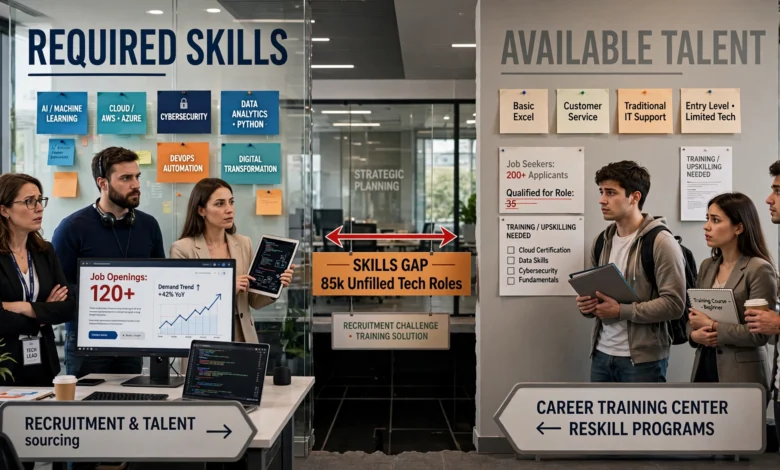
A skills gap this wide should worry anyone paying tuition or running a hiring desk. Nearly 70% of employers now say they use some form of skills-based hiring, yet more than half still report that colleges aren’t producing graduates who can do the job on day one. Something in the pipeline between classroom and cubicle is broken, and it isn’t a small crack. It’s a structural mismatch that’s been building for years and shows no sign of closing on its own.
Here’s the strange part: it’s not that students aren’t trying, and it’s not that schools have stopped caring. Most students genuinely believe they’re prepared. Most institutions genuinely believe their curriculum reflects real-world needs. And yet, survey after survey shows employers walking away unconvinced. Only around a third of recruiters currently believe new graduates are ready for the workforce, even though the overwhelming majority of graduates feel confident walking in the door. That gap in perception, not just in skill, is where a lot of the real damage happens.
This article breaks down where the disconnect actually comes from, what specific skills employers say they need versus what schools are actually teaching, why the gap keeps widening instead of narrowing, and what students, parents, and institutions can do about it right now. If you’ve ever wondered why a 4.0 GPA doesn’t always translate into a job offer, this is the explanation.
What the Skills Gap Actually Means
The term skills gap gets thrown around loosely, so it’s worth pinning down. A skills gap describes a mismatch between the abilities employers need to fill a role and the abilities candidates actually bring to the table. It’s not the same as a labor shortage, where there simply aren’t enough people applying. It’s a quality problem, not a quantity problem. Plenty of applicants show up. Fewer of them can demonstrate they can actually do what the job requires.
Congressional research on the topic points out that skills gaps show up differently depending on the skill category. A shortage in foundational skills, like reading comprehension or numeracy, ripples across nearly every occupation, while a shortage in a specific technical skill might only affect one industry. That distinction matters because it explains why the skills gap conversation never has one single fix. Some of it is basic literacy and reasoning. Some of it is digital fluency. And a growing chunk of it is what’s often called “soft skills,” even though there’s nothing soft about them when you’re the one missing them in an interview.
Why Employers Say Graduates Aren’t Ready
This is where the numbers get uncomfortable. According to recent workforce readiness research, employers rate the importance of communication skills at nearly 99%, but they only rate actual graduate proficiency in that same skill at around 55%. That’s a 43-point gap. Critical thinking shows almost the exact same pattern: rated as critically important by more than 93% of employers, but observed as proficient in only half of new hires.
Here’s the list of skills employers consistently flag as most important, paired with where graduates tend to fall short:


- Teamwork — highly valued, but often untested in academic settings where individual grades dominate
- Problem-solving — employers want evidence of applied reasoning, not textbook answers
- Verbal communication — strong on paper, weaker in live, high-pressure conversations
- Technical and digital skills — tools change faster than most curricula can update
- Written communication — clarity and brevity, not academic-style long-form writing
- Professionalism — things like deadline management, workplace etiquette, and accountability
One striking detail from hiring research: only around 16% of employers are satisfied when a resume simply lists a skill without evidence behind it. Almost none accept a bare, unsupported list. Employers aren’t just scanning for keywords anymore. They want proof, meaning a specific example of when a skill was used and what came of it. That’s a very different standard than what most coursework rewards, where the goal is usually to demonstrate knowledge of a concept, not to show a track record of applying it under real conditions.
The Demonstration Gap
This particular slice of the skills gap deserves its own name because it’s so common: the demonstration gap. Students often do have the skills employers want. What they lack is the ability to articulate those skills in language a hiring manager recognizes. A student who led a group project, managed a shifting deadline, and resolved a conflict between teammates has technically demonstrated teamwork, problem-solving, and communication. But if their resume just says “team player,” none of that comes through.
This is one of the more fixable parts of the skills gap, and it’s also one of the most overlooked. It’s not about acquiring new abilities. It’s about translating existing ones into evidence.
What Students Think Employers Want (And Why It’s Off)
There’s a perception problem sitting underneath the skills gap that doesn’t get enough attention. When students are asked what they think employers value most, the top answers are usually time management, work ethic, and general communication, each cited by well over 80% of students surveyed. Those aren’t wrong exactly, but they’re incomplete, and they reflect the vocabulary of job postings rather than the actual criteria used in interviews.
Job listings tend to use vague, safe phrases like “strong communicator” or “ability to work independently.” Students read those phrases at face value and prepare accordingly. Meanwhile, the actual evaluation happening in the interview room is often built around a completely different axis, things like critical thinking under pressure, adaptability when a task changes shape mid-conversation, or the ability to walk through a real decision and explain the reasoning behind it.
There’s also a striking gap in how each side views the value of a degree itself. In one recent higher education survey, just over half of students believed their degree justified its cost. Among recruiters asked the same question, agreement dropped to roughly 22%. That 31-point difference doesn’t mean recruiters think degrees are worthless. It means the credential isn’t communicating what employers actually want to know, which is whether the person holding it can perform.
Where Schools Are Falling Behind
To be fair to educators, closing a skills gap this wide isn’t simple. Curricula are built on multi-year cycles, get approved through layers of committees, and often can’t be rewritten fast enough to track a labor market that shifts every few quarters. A course designed five years ago may already be teaching tools or frameworks that have quietly become outdated, particularly in fields like technology, finance, and business services where the pace of change is relentless.
A few specific patterns show up again and again:
- Assessment favors individual performance over collaborative output. Group projects exist, but grading is still mostly built around what one person can prove they know on a test.
- Coursework rewards theory over applied practice. Understanding a concept and being able to execute it under real constraints are two different skills, and only one of them gets consistently graded.
- Career-readiness instruction is inconsistent. Some schools embed it deeply into every course; others treat it as an optional workshop students may never attend.
- Feedback loops with employers are thin. Few programs have a structured, ongoing channel for local employers to say what’s missing before it becomes a pattern across an entire graduating class.
- Digital and AI fluency instruction lags behind adoption. Employers are already asking for AI-related skills in entry-level postings, and that share is growing every hiring cycle, but most programs are still catching up.
None of this means schools have failed outright. It means the system was built for a slower-moving job market, and the job market stopped moving slowly a while ago.
The Skills-Based Hiring Shift, and Why It’s Not the Full Fix
You’ve probably heard that skills-based hiring is replacing degree requirements. It’s true, to a point. A large majority of employers now say they’ve adopted some form of skills-based hiring, and the trend is growing year over year. But research from Harvard Business School and the Burning Glass Institute found a gap between what companies announce publicly and what actually changes in their hiring decisions. Even when a degree requirement is officially dropped from a job posting, it barely moves the needle on who actually gets hired.
That’s an important caveat for anyone hoping skills-based hiring will simply erase the credential problem. It won’t, at least not yet. What it does mean is that candidates who can clearly demonstrate applied ability, through portfolios, certifications, project work, or assessments, have a real edge over candidates who can only point to a transcript. The skills gap doesn’t close because a job posting drops a degree requirement. It closes when a candidate can prove, concretely, that they can do the work.
How Students Can Close the Gap Themselves
Waiting for institutions to catch up isn’t a great strategy if you’re trying to land a job this year. A few moves consistently help close the personal version of the skills gap:
- Build a portfolio, not just a resume. Concrete work samples do more convincing than a bullet-point list ever will.
- Translate coursework into outcomes. Instead of “completed group research project,” describe the problem, your specific role, and the measurable result.
- Chase internships and apprenticeships aggressively. Real workplace exposure closes the demonstration gap faster than almost anything else.
- Get comfortable with AI tools relevant to your field. Employers are already screening for this, and the share of entry-level jobs listing AI skills is climbing.
- Practice explaining your reasoning out loud. Interviews increasingly test how you think, not just what you know.
- Seek out feedback from actual practitioners, not just professors, since the standards professionals apply often differ from academic grading criteria.
None of this requires waiting on a curriculum redesign. It’s work an individual student can start doing this semester.
What Institutions and Employers Can Do Together
Closing a national-level skills gap takes more than individual effort, though. A few structural fixes come up repeatedly in workforce research:
- Build direct feedback channels between employers and career centers, so curriculum adjustments happen based on real hiring data instead of assumptions.
- Expand applied learning requirements, like co-ops, capstones, and structured internships, so students graduate with demonstrable experience, not just credit hours.
- Coach the demonstration gap explicitly. Career centers that teach students how to translate coursework into employer language see measurably better outcomes.
- Update technical and AI curriculum on a faster cycle, since a two-year lag in a fast-moving field can mean graduating with skills that are already outdated.
- Track outcomes, not just placement rates. Whether a graduate is actually using the skills they were taught, and being retained in their role, tells you far more than a simple employment percentage.
Some of this is already happening. Reporting from groups like NACE shows employers steadily expanding skills-based hiring practices, and a growing share of entry-level postings now explicitly list AI-related requirements. But the pace still isn’t matching the speed at which workplace expectations are shifting, and that’s exactly why the gap keeps showing up in survey after survey instead of closing.
The Bottom Line on the Skills Gap
None of this is a story about students being lazy or schools being incompetent. It’s a timing and communication problem. The workplace is evolving faster than most academic systems were ever built to handle, and the language students use to describe their abilities often doesn’t match the language employers use to evaluate them.
The skills gap persists not because the raw talent isn’t there, but because it isn’t being translated, demonstrated, or updated fast enough to meet the moment. Closing it will take faster curriculum cycles, more applied learning, tighter feedback loops between classrooms and workplaces, and students who are willing to prove what they can do rather than simply list it.
The employers who figure out how to evaluate potential rather than credentials, and the schools that figure out how to teach demonstration rather than memorization, are the ones who will actually close this gap instead of just talking about it.