Healthy Conflict vs Toxic Relationship: 9 Powerful Signs to Spot the Difference
Healthy conflict vs toxic relationship: how to tell normal arguments from harmful patterns, with clear signs and steps for each.
Healthy conflict vs toxic relationship is a question a lot of people quietly ask themselves after a bad fight. You argued again. Someone raised their voice, someone went silent, and now you’re lying awake wondering if this is just what couples do or if something is actually wrong.
Here’s the honest answer: every close relationship has conflict. Couples who never disagree usually aren’t happier. They’re often just avoiding the hard conversations. So the presence of arguments tells you very little. What matters is how you argue, how you recover, and how you feel about yourself afterward.
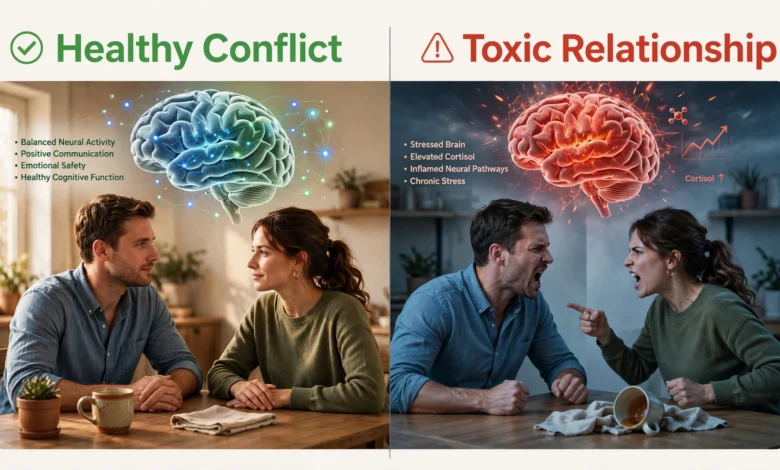
Healthy conflict is uncomfortable but safe. Both people can speak, both people get heard, and the fight is about a problem you’re trying to solve together. A toxic relationship is different. The arguments follow a pattern of blame, contempt, control, or fear, and over time you start to feel smaller.
The tricky part is that the two can look similar from the outside. Raised voices, tears, and slammed doors can happen in both. That’s why this guide focuses on patterns, not single moments. Below, you’ll find what healthy conflict looks like, what makes a relationship toxic, nine clear signs of a toxic relationship compared side by side with healthy behavior, and practical steps for fighting fair or deciding when it’s time to leave.
What Healthy Conflict Actually Looks Like
Healthy conflict is a disagreement where both people stay on the same team. You might be frustrated, hurt, or loud, but the goal is to understand each other and fix the problem, not to win or punish.
The goal is resolution, not victory
In a healthy argument, the question underneath is “How do we sort this out?” rather than “How do I prove I’m right?” One partner might say, “I felt ignored when you were on your phone all through dinner.” The other might get defensive at first, but they eventually listen and respond to the actual concern.
This is what researchers call constructive conflict. It focuses on a specific issue, it stays mostly in the present, and it ends with some kind of shared understanding, even if you don’t fully agree.


Both people feel safe speaking up
Safety is the backbone of healthy conflict resolution. You can bring up something that bothers you without bracing for punishment later. You don’t rehearse every sentence to avoid setting your partner off. You might worry about an awkward conversation, but you don’t fear the person.
Repair happens afterward
No couple argues perfectly. People say things they regret. The difference is that healthy couples come back and repair. That might look like:
- A real apology that names what went wrong, not “I’m sorry you feel that way”
- A check-in the next day: “Can we talk about last night now that we’ve both calmed down?”
- A small gesture of reconnection, like a hug, a joke, or making coffee for the other person
- A concrete change in behavior so the same fight doesn’t repeat every week
Why conflict can be good for you
It sounds strange, but couples who handle disagreements well often end up closer. Healthy conflict helps you:
- Learn what your partner actually needs instead of guessing
- Set clear boundaries early, before resentment builds
- Build trust, because you’ve seen that you can disagree and still be okay
- Solve real problems around money, chores, family, or intimacy instead of letting them fester
The research from the Gottman Institute, which has studied couples for decades, backs this up. Happy couples still argue. They just argue with less contempt and more repair.
What Makes a Relationship Toxic
A toxic relationship is one where harmful patterns repeat, rarely get repaired, and slowly wear down one or both people. It isn’t defined by a single bad night. It’s defined by what keeps happening.
Patterns over moments
Anyone can snap when they’re exhausted or stressed. That alone doesn’t make a relationship toxic. The concern starts when the same hurtful behavior shows up again and again: the mocking tone every time you disagree, the silent treatment that lasts for days, the way every conversation about their behavior somehow becomes a conversation about yours.
The Four Horsemen of destructive conflict
Dr. John Gottman identified four behaviors that predict relationship breakdown with striking accuracy. You can read the full breakdown in the Gottman Institute’s guide to the Four Horsemen of criticism, contempt, defensiveness, and stonewalling. In short:
- Criticism: attacking your partner’s character instead of their behavior (“You’re so selfish” instead of “I needed help tonight”)
- Contempt: eye-rolling, sneering, mockery, and name-calling. Gottman considers this the single strongest predictor of divorce
- Defensiveness: refusing any responsibility and flipping blame back every time
- Stonewalling: shutting down completely and refusing to engage
Most couples slip into one of these now and then. In a toxic dynamic, they become the default way you talk to each other.
Toxic is not always abuse, but it can be
It helps to separate two ideas. Some toxic patterns come from two people with poor conflict skills hurting each other. Those can sometimes improve with effort and support.
Emotional abuse is different. Abuse is a pattern of power and control, where one person uses fear, intimidation, isolation, or manipulation to dominate the other. It is not a communication problem you can fix by learning better “I statements.” If that sounds like your situation, safety comes first, and the section on abuse warning signs below is for you.
Healthy Conflict vs Toxic Relationship: 9 Signs That Show the Difference
The clearest way to understand healthy conflict vs toxic relationship dynamics is to put them next to each other. Here’s a quick comparison, followed by a closer look at each sign.
| Sign | Healthy conflict | Toxic relationship |
|---|---|---|
| 1. Focus of the fight | The issue at hand | Your character or worth |
| 2. Respect | Kept even when angry | Contempt, insults, mockery |
| 3. Feeling safe | You can speak freely | You walk on eggshells |
| 4. Accountability | Both own their part | Blame always lands on you |
| 5. Repair | Apologies and change follow | Same fight, no change |
| 6. Frequency | Occasional, tied to real problems | Constant, often out of nowhere |
| 7. Control | Decisions are shared | One person controls the other |
| 8. Honesty | Disagreement without distortion | Gaslighting and denial |
| 9. How you feel after | Tired but connected | Drained, confused, smaller |
1. The fight is about a problem, not about who you are
In healthy conflict, the argument has a topic: the dishes, the budget, the in-laws, a missed text. Even heated, it stays tied to that topic. In a toxic relationship, small issues quickly turn into attacks on your character. Forgetting to call becomes proof that you’re “useless” or “don’t care about anyone but yourself.”
2. Respect survives the anger
Healthy couples can be furious and still respectful. They don’t mock each other’s feelings, call names, or humiliate each other in front of friends. Contempt is one of the clearest relationship red flags because it signals that one person sees the other as beneath them.
3. You feel safe, not scared
This is one of the most important questions you can ask yourself. Do you avoid bringing things up because the conversation will be awkward, or because you’re afraid of how they’ll react? Feeling like you have to walk on eggshells, monitor their mood, or manage their anger to keep the peace is a sign the problem goes beyond normal conflict.
4. Both people take responsibility
In a healthy dynamic, both partners can say, “You’re right, I handled that badly.” Not every time, and not always right away, but it happens. In a toxic one, accountability only flows one direction. Somehow it’s always your fault, including their reaction to your behavior.
5. Repair actually happens
Healthy couples have what researchers call repair attempts: apologies, humor, a softer tone, a hand on the shoulder. More importantly, the behavior changes. In toxic relationships, you may get apologies, sometimes intense ones, but the same pattern returns a week later. An apology without change eventually stops meaning anything.
6. Conflict is occasional, not constant
All couples go through stressful seasons with more arguments than usual, like a new baby, a job loss, or a move. That’s normal. But if fighting is the background noise of your relationship, or fights seem to start out of nowhere over tiny things, that points to something deeper.
7. Nobody is in charge of the other person
Healthy partners make decisions together and respect each other’s independence. Controlling behavior looks different. It can include checking your phone, deciding who you see, controlling money, or getting angry when you spend time without them. Control is often framed as care (“I just worry about you”), which makes it harder to spot.
8. Disagreement without distorting reality
You can see an event differently from your partner and still trust that you’re both being honest. Gaslighting is when someone repeatedly denies things that happened, rewrites events, or tells you you’re too sensitive or imagining things, until you start to doubt your own memory. If you’ve started keeping notes or screenshots just to trust your own version of events, take that seriously.
9. How you feel afterward
This may be the most telling sign of all. After a healthy argument, you might feel tired, a bit raw, but basically okay, and often closer once it’s resolved. After toxic conflict, you feel drained, anxious, confused, or ashamed. Over months, toxic relationships chip away at your self-esteem and your sense of who you are. If you barely recognize yourself compared to a few years ago, notice that.
The Gray Area: When It’s Hard to Tell
Most relationships don’t fit neatly into “healthy” or “toxic.” Plenty of decent couples have a few unhealthy habits. Maybe one of you shuts down during fights, or the other gets sarcastic when stressed. That doesn’t automatically mean the relationship is doomed.
A few questions can help you sort out where you stand:
- Is the bad behavior mutual or one-sided? Two people with clumsy conflict skills is different from one person consistently harming the other.
- Does it change when it’s pointed out? A partner who hears “That comment really hurt” and adjusts is very different from one who doubles down.
- Is it getting better or worse over time? Healthy relationships tend to improve as people learn each other. Toxic ones tend to escalate.
- Would you be comfortable if a close friend saw how you argue? If you hide your fights out of embarrassment or fear, pay attention to that instinct.
Healthy Conflict vs Toxic Relationship Warning Signs That Point to Abuse
Some behaviors go beyond “toxic” and into emotional abuse or physical danger. These are not conflict styles. They are serious warning signs:
- Threats to hurt you, themselves, your children, or your pets
- Any physical violence, including pushing, grabbing, blocking doorways, or throwing things
- Isolating you from friends and family
- Monitoring your location, messages, or spending without your agreement
- Pressuring or forcing you into sexual activity
- Making you afraid to leave or to say no
If any of these sound familiar, “working on communication” is not the right fix, and couples counseling is often not recommended when abuse is present. Reach out to a trained advocate. In the US, the National Domestic Violence Hotline offers free, confidential support by phone, text, and chat. Outside the US, look for a local domestic violence helpline or women’s support organization in your country.
How to Practice Healthy Conflict Resolution
If your relationship sits in the gray area and both of you want to do better, the good news is that conflict resolution skills can be learned. Here are practical habits that help couples fight fair.
Start softly
How a conversation begins strongly shapes how it ends. Lead with how you feel and what you need, not an accusation. “I’ve been feeling overwhelmed with the housework and I’d love more help” lands very differently than “You never do anything around here.”
Use “I” statements
Speak from your own experience. “I felt embarrassed when you made that joke in front of my friends” opens a conversation. “You humiliated me on purpose” starts a defense.
Take breaks when you’re flooded
When your heart is pounding and you can’t think clearly, nothing productive happens. Agree on a signal for a timeout, take 20 to 30 minutes to calm down, and then actually come back. The return is what separates a break from stonewalling.
Listen to understand
Try repeating back what you heard before you respond: “So you’re saying you felt left out when I made plans without asking?” It slows things down and shows your partner you’re listening.
Stick to one issue
Resist the urge to bring up every past grievance. “Kitchen sinking” turns a solvable problem into an unwinnable war.
Repair and follow through
Apologize specifically, then change something. Repair is what turns conflict into trust.
Get outside help
A couples therapist can help you spot patterns you can’t see from inside them. Individual therapy can also help you understand your own reactions and what you want from a relationship.
When to Walk Away From a Toxic Relationship
Leaving is a personal decision, and only you can make it. Still, some signs suggest a relationship may not be fixable, at least not right now:
- Your partner refuses to acknowledge any problem or take responsibility
- You’ve tried counseling, clear conversations, and boundaries, and nothing changes
- You feel afraid of your partner, not just afraid of conflict
- Your physical or mental health is suffering
- Friends and family have expressed real concern about how you’re being treated
If you decide to leave, plan carefully, especially if there’s any history of control or violence, since leaving can be a risky time. Lean on people you trust and use professional resources. Choosing to protect your well-being is not giving up. It’s taking yourself seriously.
Conclusion: Healthy Conflict vs Toxic Relationship
The real difference in healthy conflict vs toxic relationship patterns isn’t whether you argue, because every couple does. It’s whether you feel safe, respected, and heard while you disagree, and whether things actually get repaired afterward. Healthy conflict stays focused on the problem, allows both people to take responsibility, and often leaves you closer than before.
A toxic relationship runs on contempt, blame, control, and fear, and it slowly erodes your confidence and sense of self. If your relationship sits in the gray area, better conflict resolution skills and outside support can make a real difference. If you recognize the warning signs of abuse, put your safety first and reach out for help. Either way, trust what you feel after the fight; it usually tells you more than the fight itself.