Chronic Stress Changes Your Brain: 7 Proven, Damaging Effects Over Time
Chronic stress can shrink your memory centers and strengthen your fear circuitry. Here is how your brain changes over time, and what helps it recover.
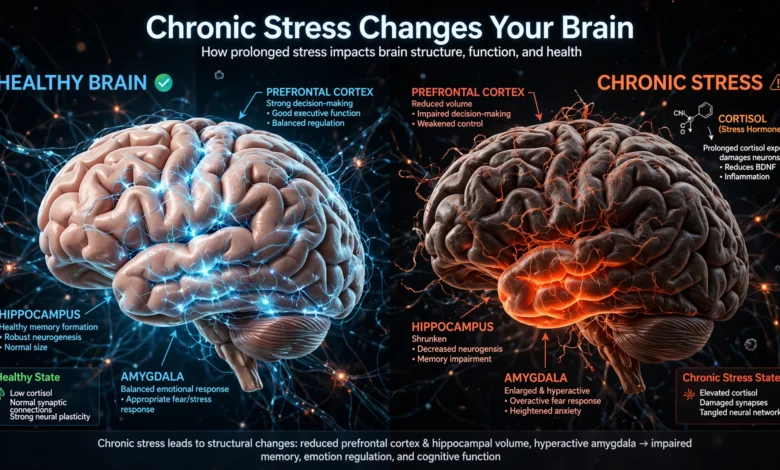
Chronic stress does not just leave you tired and on edge. It leaves marks you can measure on a brain scan. Researchers have linked long-term stress to a smaller hippocampus, a more reactive amygdala, and a prefrontal cortex that struggles to keep you organized and calm. These changes build slowly. That is why many people never connect their forgetfulness, short temper, or constant worry to the pressure they have carried for months or years.
The good news is that the brain stays adaptable. The same neuroplasticity that lets chronic stress reshape your brain also lets it recover once the pressure eases and you give it the right support. Many of these changes are reversible, and none of them is a life sentence.
This article walks through what happens inside your head when stress stops being a short burst and becomes a daily companion. You will see how the stress response works, which brain regions take the hit, what those changes feel like in ordinary life, and which habits have the best evidence for helping you recover. The science is explained in plain language, so you can spot the warning signs early and act on them.
If you have ever wondered why you cannot focus, why small problems feel huge, or why your memory is worse than it used to be, chronic stress may be part of the answer.
How Chronic Stress Works Inside Your Brain
Stress is the way your brain and body respond to a demand. The demand can be a deadline, an argument, a loud noise, or a scary diagnosis. In small doses, the stress response helps you. It sharpens your attention, speeds up your heart, and sends fuel to your muscles so you can deal with whatever is in front of you.
The trouble starts when the demand never lets up. The National Center for Complementary and Integrative Health points out that stress touches both mind and body, and that long-lasting stress can wear down your health.
The HPA Axis and the Stress Hormone Cortisol
Here is the chain of events. Your amygdala spots a possible threat and alerts the hypothalamus. The hypothalamus signals the pituitary gland, and the pituitary signals the adrenal glands, which sit on top of your kidneys. The adrenals then release adrenaline and cortisol, the main stress hormone. Scientists call this relay the HPA axis, short for hypothalamic-pituitary-adrenal axis.


Cortisol does useful work. It raises blood sugar, adjusts your immune response, and keeps you alert. When the danger passes, cortisol travels back to the brain and tells the hippocampus and prefrontal cortex to switch the alarm off. That feedback loop is the brake on your stress system.
Acute Stress vs. Chronic Stress
Acute stress is short. Your body ramps up, handles the problem, and settles back down. A little short-term stress can even help you learn, because it sharpens your attention while you take in new information.
Chronic stress works differently. It keeps the HPA axis running week after week, so your brain sits in a bath of stress hormones. The feedback brake wears out, and cortisol may be released in uneven bursts. As Psych Central explains, that means you feel stressed more of the time and in more situations. Common sources of chronic stress include:
- Ongoing job strain or job insecurity
- Money worries that never ease
- Caring for a sick or aging family member
- A difficult relationship or an unsafe home
- Living with pain or a long-term illness
- Loneliness, discrimination, or constant exposure to bad news
The type, length, and intensity of stress all matter. So do your age, sex, genes, and the support around you. Two people under the same pressure can end up with different effects on the brain.
7 Ways Chronic Stress Changes Your Brain Over Time
A quick caution before the list. Much of the cell-level research comes from animal studies, and human imaging studies show patterns across groups, not guaranteed results for any one person. Treat these changes as tendencies.
1. Chronic Stress Shrinks the Hippocampus
The hippocampus is a seahorse-shaped structure that helps you form new memories and file them in context. It is packed with cortisol receptors, which makes it very sensitive to stress hormones.
When chronic stress keeps cortisol high, the hippocampus takes a beating. Its neurons pull back their branches, and imaging studies have tied long-term stress and depression to a smaller hippocampal volume. In daily life, that can look like trouble learning new things, losing your train of thought, or memory loss that seems out of proportion to your age.
Animal studies also show that chronic stress slows the birth of new neurons in one part of the hippocampus. Whether adult humans make many new neurons is still debated, so researchers are careful with that claim. What most agree on is that memory circuits work worse under sustained stress. There is also a feedback problem, because the hippocampus helps turn off the stress response. A weaker hippocampus makes the brake weaker too.
2. Chronic Stress Makes the Amygdala More Reactive
The amygdala is your brain’s threat detector. It scans for danger and sets off the alarm. Where chronic stress tends to shrink the hippocampus, it tends to do the opposite to the amygdala. Neurons there can grow more branches, and the region becomes more active.
The practical result is an overactive alarm. You notice threats faster, you react harder, and you calm down more slowly. This is one reason chronic stress and anxiety so often show up together. There is also a use-it-or-strengthen-it effect. The more often your brain rehearses fear, the stronger that circuit becomes, and the easier it is to trigger next time.
3. Chronic Stress Weakens the Prefrontal Cortex
The prefrontal cortex sits behind your forehead. It handles planning, decision-making, working memory, and impulse control. It also helps you regulate emotions by talking the amygdala down.
Chronic stress hits this region hard. Studies in animals show that neurons in parts of the prefrontal cortex lose branches and connection points under repeated stress. Human research has linked higher cortisol levels to a lower volume in several parts of this region. Even short bouts of uncontrollable stress can temporarily knock the prefrontal cortex offline, so long-term stress makes that dip a regular experience.
What does that feel like? Brain fog, poor decisions, trouble juggling tasks, and a habit of reaching for whatever is easiest, whether that is snacks, scrolling, or snapping at someone.
4. Chronic Stress Thins Out Connections Between Neurons
Neurons talk to each other through tiny branches called dendrites and even tinier connection points called spines. This physical wiring is what neuroplasticity reshapes every day, in both directions.
Under chronic stress, dendrites and spines tend to shrink in the hippocampus and prefrontal cortex, while the amygdala gains more of them. That shift matters because it changes the balance of power in your brain. The regions that help you think clearly and remember well lose some capacity, and the region that scans for danger gains some. Your brain’s structure starts to favor vigilance over reflection.
5. Chronic Stress Disrupts Communication Between Brain Regions
A healthy brain works like a team. The prefrontal cortex sends calming, top-down signals to the amygdala, and the hippocampus supplies context so you can tell a real threat from a harmless one.
Chronic stress weakens these links. When the connection between the prefrontal cortex and the amygdala loosens, the amygdala runs with less supervision. Your emotional reactions get bigger and harder to control, and your ability to step back and say “this is not an emergency” gets smaller. Researchers who study brain networks have also reported shifts in how large-scale networks coordinate under prolonged stress, which fits with how scattered and reactive many stressed people feel.
6. Chronic Stress Disturbs Sleep and the Reward System
Stress chemicals keep the brain in a state of high arousal, and that pushes sleep away. Poor sleep then makes the next day’s stress harder to handle, which feeds the cycle. Sleep matters here because it supports memory storage and the brain’s routine maintenance, so losing it night after night adds to the strain on the hippocampus and prefrontal cortex.
Stress also affects the reward system, the circuitry that produces motivation and pleasure. When that system is dulled, things you used to enjoy feel flat. This is linked to low mood, low drive, and a stronger pull toward quick fixes like alcohol, junk food, or endless scrolling.
7. Chronic Stress Leaves Deeper Marks When It Starts Early
The brain is still under construction in childhood and adolescence, which makes it more sensitive to prolonged stress. Early adversity has been linked to differences in how the amygdala and prefrontal cortex develop, and to changes in how genes get switched on and off. That process is called epigenetics. Chronic stress may also raise inflammation in the body, which can influence brain function.
Some of these early changes can last into adulthood. That does not mean they are permanent or that recovery is out of reach. Supportive relationships, therapy, and safer surroundings all help the brain rebuild, and the earlier that support arrives, the better.
What Chronic Stress Feels Like in Daily Life
Brain changes are invisible, but their effects are not. Here are the most common signs, roughly in the order people notice them:
- Memory slips. You forget names, appointments, or why you walked into a room.
- Brain fog. Thinking feels slow, and simple tasks take more effort than they should.
- A short fuse. Small annoyances trigger big reactions.
- Constant worry. Your mind keeps scanning for what could go wrong.
- Poor sleep. You either cannot fall asleep or wake up at 3 a.m. with your mind racing.
- Flat mood and low motivation. Things you used to enjoy no longer land.
- Trouble deciding. Even minor choices feel exhausting, or you put them off.
- Physical tension. Headaches, tight shoulders, and stomach trouble are common.
None of these proves that chronic stress is the cause. Sleep disorders, thyroid problems, depression, and many other conditions can look similar. If several of these signs stick around, a doctor can help you sort out what is going on.
Can Your Brain Recover From Chronic Stress?
In many cases, yes. Animal studies show that dendrites can regrow after stress ends, and some brain changes fade once the pressure lifts. Human research is more limited, but it points the same way.
- Exercise: In a widely cited trial of older adults, a year of regular walking increased hippocampal volume by roughly 2 percent, which reversed part of the typical age-related shrinkage.
- Mindfulness training: Several small studies report lower amygdala reactivity and changes in gray matter after mindfulness-based programs. Results are mixed, and the studies are small, so this is promising rather than settled.
- Therapy: Cognitive behavioral therapy and similar approaches help retrain the prefrontal cortex to regulate emotion, and they can reduce anxiety and depression linked to long-term stress.
Recovery is not instant. Expect weeks to months, not days, and expect progress to be uneven. The earlier you act, the less time the stress-driven patterns have to settle in.
Practical Ways to Protect Your Brain From Chronic Stress
You cannot remove every source of stress, but you can change how much of it your brain has to absorb. These steps have the strongest support.
Move Your Body Most Days
Aim for something you can keep doing, such as a brisk 30-minute walk. Exercise lowers stress hormones over time, supports the hippocampus, and improves sleep and mood. It does not need to be intense to count.
Protect Your Sleep
Most adults do best with at least seven hours. Keep a steady wake-up time, keep screens out of bed, and cut back on caffeine in the afternoon. Good sleep gives your prefrontal cortex a real chance to recover overnight.
Build Real Connection
Talking with people you trust is one of the best buffers against stress. Ask for help before you hit a wall. Even a short conversation with a friend can settle your stress response faster than another hour of worrying alone.
Practice One Calming Skill
Pick a technique and stick with it. Slow breathing, a short body scan, a daily walk without your phone, or a few minutes of mindfulness all work. The skill matters less than the consistency, because you are training your brain to switch off the alarm.
Reduce the Source Where You Can
Set limits on work hours, say no to extra commitments, and break large problems into smaller steps. Write down what is in your control and what is not, then put your energy into the first list. Small changes to the source often beat any amount of coping.
When to Talk to a Professional
Reach out for help if stress has lasted for weeks and is affecting your sleep, work, relationships, or mood. Also reach out if you are leaning on alcohol or other substances to cope. A doctor or mental health professional can check for other causes and suggest treatment. The National Institute of Mental Health has a page on how to find help that walks you through your options.
If you ever have thoughts of harming yourself, contact your local emergency services or a crisis line in your country right away. You do not have to handle that alone.
Frequently Asked Questions
Does chronic stress permanently damage the brain?
Not necessarily. Some changes can last, especially when stress starts in childhood, but many are reversible when the stress eases and you get support. The brain keeps its ability to adapt throughout life.
How long does it take for chronic stress to change the brain?
There is no single timeline. Changes in brain cells can appear within weeks of repeated stress in animal studies, and human differences tend to build over months and years. How fast it happens depends on the intensity of the stress, your age, and how much support you have.
Can chronic stress cause memory loss?
It can cause memory problems, mainly by affecting the hippocampus and prefrontal cortex. These problems are often reversible. Still, if your memory is getting noticeably worse, see a doctor to rule out other causes.
Is all stress bad for the brain?
No. Short bursts of stress can sharpen attention and help you learn. The harm comes from stress that is intense, unpredictable, or never lets up, because that is when the brain has no chance to reset.
Conclusion
Chronic stress physically reshapes the brain over time, shrinking the hippocampus, sharpening the amygdala’s alarm, weakening the prefrontal cortex, thinning neural connections, and loosening the links that help these regions work together, while also disturbing sleep and the reward system and leaving deeper marks.
When it begins early, yet the same neuroplasticity that allows these changes also allows recovery, so regular exercise, protected sleep, strong relationships, a daily calming skill, and professional support when needed can help your brain rebuild and give you back your memory, focus, and calm.